

Yes, paranoia is a recognized symptom of dementia. But for families in Arlington and across Northern Virginia, seeing a loved one become deeply suspicious can be one of the most painful parts of this journey. It’s critical to understand that this isn’t a personality change or a conscious choice. It’s the result of complex, physical changes happening inside the brain as the disease progresses, and recognizing it as a medical symptom is the first step toward compassionate management.
The Link Between Cognitive Decline and Paranoia in Seniors

When a parent in Arlington or Fairfax suddenly becomes mistrustful, it's natural to feel alarmed. They might accuse you of stealing, believe neighbors are plotting against them, or feel unsafe in their own home. It’s so important to remember that these beliefs, while unfounded, feel entirely real to the person experiencing them.
Paranoia in dementia is a direct side effect of the brain’s declining ability to process information, interpret social cues, and recall memories accurately. As cognitive functions weaken, the brain struggles to make sense of the world. In its attempt to fill in the blanks left by memory loss, it can land on suspicious or fearful conclusions. For example, if your mom can't remember where she put her wallet, her damaged reasoning might lead her to believe it was stolen by a caregiver from Vienna rather than simply misplaced.
Why Understanding This Connection Matters
Recognizing paranoia as a medical symptom—not a behavioral problem—is the first and most critical step. This shift in perspective helps families move from a place of frustration to one of empathy, which is the key to managing the situation constructively.
Here's what to keep in mind:
- It’s the Disease, Not the Person: The suspicious thoughts are caused by neurological damage. Your loved one isn't choosing to be difficult or accusatory.
- Their Feelings Are Real: While the paranoid thoughts are irrational, the fear, anxiety, and distress they cause are completely genuine.
- Arguing Is Counterproductive: Trying to reason with a paranoid delusion usually backfires, making the person more defensive and agitated.
Research backs this up. While some older adults may have mild paranoid thoughts, the prevalence shoots up among those with dementia. In fact, a study in JAMA Psychiatry noted that these symptoms can even be an early indicator of a higher risk for developing dementia later in life. You can read the full research about these findings.
To help families make sense of this challenging symptom, we've put together a quick-reference table.
Paranoia in Dementia at a Glance
| Symptom Aspect | What This Means for Families in Northern Virginia |
|---|---|
| Root Cause | Neurological damage from dementia, not a personality flaw. The brain is misinterpreting reality. |
| Common Beliefs | Accusations of theft, feeling spied on, or believing others intend to cause harm. |
| Emotional Reality | The fear and distress are very real, even if the beliefs behind them are not based in fact. |
| Effective Response | Acknowledge their feelings, offer reassurance, and avoid arguing. Focus on creating a sense of safety. |
| Ineffective Response | Trying to use logic, getting frustrated, or dismissing their concerns. This often increases agitation. |
Understanding the root cause of paranoia allows families in Vienna, McLean, and Alexandria to find better strategies and support. Our GreatCare™ method emphasizes active involvement and customized care plans, and our Dementia-Great Care® program is specifically designed to give caregivers the tools to manage complex symptoms like paranoia with skill and compassion. Learning the right approach can make all the difference in restoring a sense of safety and calm for your loved one.
Recognizing Common Paranoid Behaviors

So, when we talk about whether paranoia is a symptom of dementia, what does that actually look like day to day? For families in Arlington and surrounding Fairfax County, these behaviors often start small. At first, you might just brush it off as stubbornness or a bad mood.
Over time, though, you’ll likely start to see distinct patterns emerge. Recognizing these signs for what they are—symptoms of a disease—is the first step. It helps you respond with compassion instead of frustration, remembering that the paranoia isn’t a reflection of your relationship; it's the illness talking.
Common Paranoid Thoughts and Accusations
Paranoid thoughts in dementia are almost always tied to memory loss. When the brain can no longer find a piece of information, it tries to fill in the blanks with a story that makes sense. Unfortunately, that story is often one of suspicion.
Here are some of the most frequent paranoid delusions we see:
- Accusations of Theft: This is probably the most common. A loved one insists that a family member, caregiver, or neighbor is stealing their money, jewelry, or other valuables. The reality is they've likely misplaced the item but can't remember where they put it.
- Belief of Being Poisoned: Your mom or dad might suddenly refuse to eat food you’ve prepared or take their medication, convinced it has been tampered with. This often comes from a deep-seated fear of being harmed or controlled.
- Spousal Infidelity: A devoted husband of 50 years might suddenly accuse his wife of having an affair. This is usually triggered by confusion over schedules, unfamiliar faces, or a simple misinterpretation of a conversation.
- Fear of Abandonment: It's heartbreaking, but many seniors with dementia develop a persistent fear that their family plans to leave them in a hospital or facility, even when that couldn't be further from the truth.
These beliefs, however irrational they seem to us, feel 100% real to the person experiencing them. Their fear and anxiety are genuine, and responding with empathy is crucial to de-escalating the situation.
Behaviors Fueled by Paranoia
Paranoid thoughts don't just stay in the mind; they almost always lead to specific actions. These behaviors are the outward signs that something is wrong and are often the first things families in Vienna or Alexandria notice.
You might observe your loved one:
- Hiding Possessions: Finding a wallet in the freezer, a purse under the mattress, or car keys in a sugar bowl are classic signs. They're trying to protect their belongings from the "thieves" they believe are targeting them.
- Social Withdrawal: They may pull away from friends, neighbors, or even close family members they suddenly distrust, leading to increased isolation.
- Refusing Help: Paranoid thoughts can cause a senior to reject assistance from family or professional caregivers, believing they have ulterior motives or are trying to harm them.
- Increased Agitation or Aggression: When someone feels threatened, unheard, or backed into a corner, they may become verbally or even physically aggressive. For a person with dementia, this is pure self-defense against a perceived threat.
Identifying these behaviors for what they are is the first step toward creating a safer, more reassuring environment for your loved one.
Why Dementia Leads to Paranoid Thoughts

To really help your loved one, you have to get to the "why" behind their paranoid thoughts. It's a tough but crucial step. These suspicions aren't coming from a place of meanness or a sudden personality shift; they're a direct symptom of physical changes happening inside the brain. Once you understand the cause, you can start providing compassionate care that gets to the root of the behavior, not just the surface-level symptom.
Imagine the brain with dementia is like a computer running on corrupted software. It still boots up, but information gets lost, jumbled, or completely misinterpreted. When that happens, the brain’s natural instinct is to fill in the gaps. It creates a story to explain what it can no longer figure out logically.
The Brain's Wiring and Misinterpreted Signals
Dementia steadily damages different parts of the brain, messing up their ability to talk to each other. This communication breakdown is a major driver of paranoia. Two key areas are often hit hard:
- The Frontal Lobe: Think of this as the brain’s CEO—the center for reasoning and judgment. It helps us think logically, solve problems, and keep our impulses in check. When dementia damages the frontal lobe, a person’s ability to rationally size up a situation goes downhill, making them far more likely to believe irrational fears.
- The Amygdala: This is the brain's alarm system, our fear and emotional center. It processes threats and kicks off our "fight or flight" response. In a healthy brain, the frontal lobe acts as a brake on the amygdala. But with dementia, an overactive amygdala can send out constant fear signals without the frontal lobe's ability to step in and say, "Hold on, everything's fine."
This neurological short-circuit means a simple, harmless event—like a caregiver quietly closing a door—can be misinterpreted as a secretive, threatening act. The brain simply can't tell the difference between a real threat and a perceived one anymore.
How Memory Loss Fills in the Blanks
Memory loss is the other huge piece of the puzzle. When a person with dementia can't remember where they put their wallet, their brain scrambles to explain its absence. Instead of thinking, "I must have misplaced it," the damaged brain might leap to a conclusion that feels more logical to them: "Someone must have stolen it."
This isn't a deliberate lie or an attempt to deceive. The brain is just creating a story to fill a void left by a forgotten memory. For the individual, this conclusion feels as real and true as any other memory.
This is exactly why arguing with facts and logic usually backfires. You're trying to reason with a brain that has lost the very tools it needs for reasoning. Instead, compassionate validation and gentle redirection become your most powerful tools. Our quality caregivers providing professional dementia care in Arlington are trained to understand these neurological changes, which allows them to respond with empathy and skill. This approach helps de-escalate fear instead of fueling it, fostering a sense of safety and trust for your loved one.
How Paranoia Manifests in Different Dementia Types
Knowing that paranoia is a symptom of dementia is one thing, but recognizing how it actually shows up is a completely different ballgame. Dementia isn't a single disease. It’s an umbrella term for many different conditions, and the paranoia that comes with it can look very different depending on the specific diagnosis.
Think of it this way: a cough can signal anything from a common cold to a more serious lung condition. In the same way, paranoia’s specific presentation offers clues about the type of dementia at play. The form of the disease determines which parts of the brain are most affected, which in turn shapes how these suspicious thoughts emerge and what triggers them.
Alzheimer's Disease and Memory-Based Paranoia
With Alzheimer's disease, the most common form of dementia, paranoia is almost always tied directly to memory loss. This makes sense, as the brain regions responsible for forming and retrieving memories are the first to be damaged.
This leads to those classic, heartbreaking scenarios where a senior can’t remember where they put their wallet and immediately concludes someone must have stolen it. To them, this isn't an irrational leap. Their paranoia is a logical explanation for a world that suddenly no longer makes sense. The suspicion is built on a foundation of forgotten information.
Dementia with Lewy Bodies and Hallucination-Fueled Paranoia
Paranoia in Dementia with Lewy Bodies (DLB) often has a completely different flavor. A key feature of DLB is the presence of vivid, recurring visual hallucinations. Someone with DLB might see people, animals, or objects in the room that simply aren't there.
These hallucinations feel entirely real and can be absolutely terrifying. The paranoia that follows is a direct reaction to these false perceptions. If a person genuinely believes there is a stranger lurking in their house, their fear and suspicion are a natural, albeit distressing, response. This type of paranoia is less about filling in memory gaps and more about reacting to a distorted sensory reality.
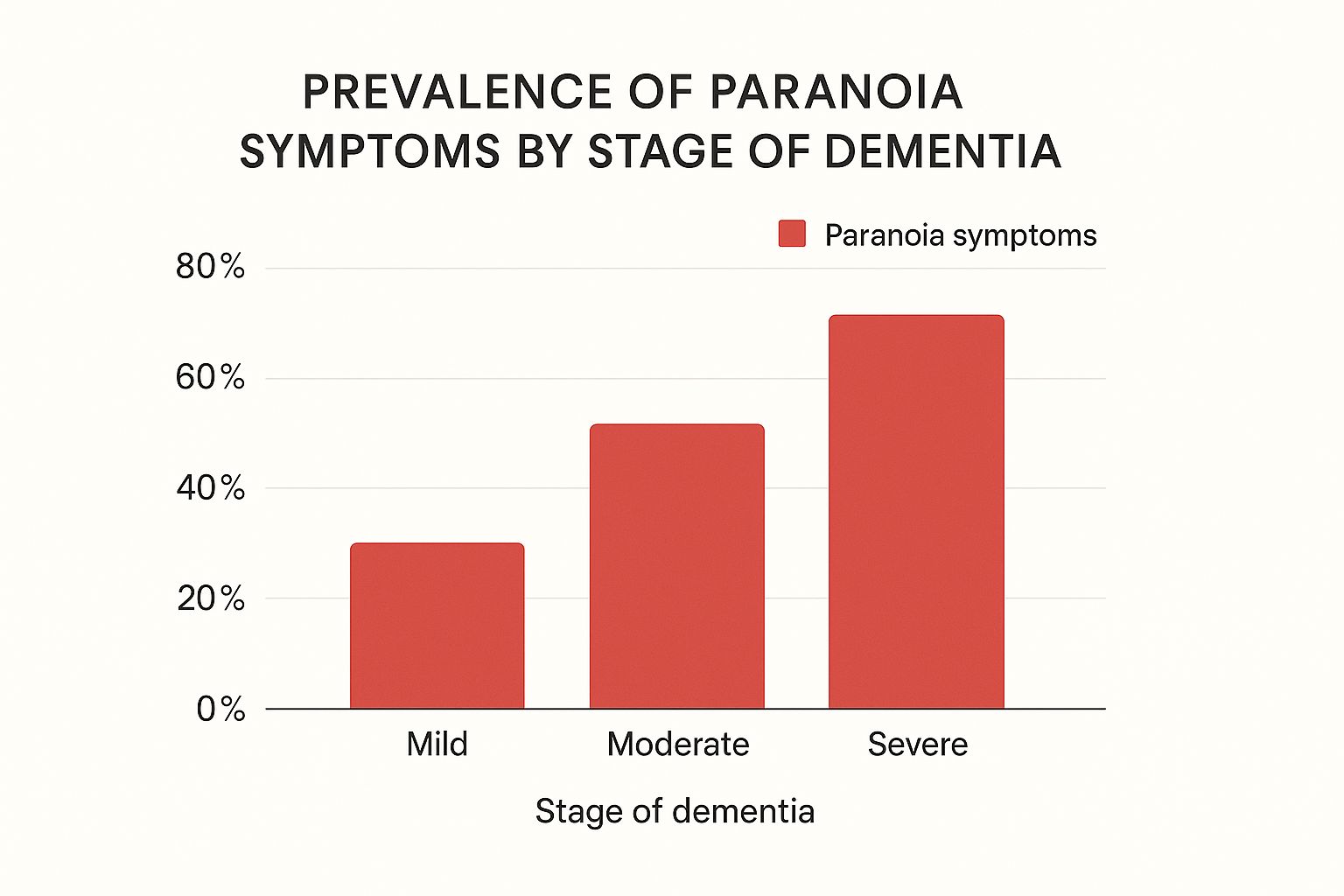
As you can see, while paranoia can certainly be present in the mild stage of dementia, it becomes significantly more common and intense as the disease progresses into the moderate and severe stages.
A Look at Paranoia Across Other Dementia Types
The likelihood of someone experiencing paranoia or other psychotic symptoms changes quite a bit from one diagnosis to another. It's not a one-size-fits-all symptom.
Below is a quick comparison of how common these symptoms are in a few major dementia types.
Paranoia Prevalence by Dementia Type
A comparative look at how commonly paranoia and related psychotic symptoms appear in different forms of dementia.
| Dementia Type | Approximate Prevalence of Psychosis (including Paranoia) |
|---|---|
| Dementia with Lewy Bodies (DLB) | Up to 75% |
| Alzheimer's Disease | Around 30% |
| Vascular Dementia | Around 15% |
| Frontotemporal Dementia (FTD) | Around 10% |
As the table shows, there's a huge range. Someone with Dementia with Lewy bodies (DLB) has a very high chance of experiencing these symptoms, while the rates for other types like vascular or frontotemporal dementia are much lower.
Recognizing these distinctions is vital for effective care. A strategy that works for memory-based paranoia in Alzheimer's probably won't be very helpful for the hallucination-driven paranoia in DLB. Customizing the approach is key to managing these challenging symptoms.
This is a core part of our specialty dementia care services, where we make sure every senior receives support that truly matches their specific condition. A personalized approach like this helps reduce distress for the person with dementia and improves the quality of life for everyone involved.
Practical Strategies for Managing Paranoia at Home
When you're faced with a loved one's paranoia, it’s easy to feel overwhelmed and unsure how to respond. The most important thing to remember is that the old rules of logic and reason no longer apply. Your focus has to shift entirely to creating a feeling of safety, trust, and calm.
For families in Arlington and Fairfax, having a few go-to strategies can make all the difference in a difficult moment. These are the same compassionate, field-tested techniques our professional caregivers use to manage challenging dementia-related behaviors. By learning these approaches, you can feel more confident and prepared, which lowers the stress for everyone involved.
Master Empathetic Communication
Your words and, more importantly, your tone are your most powerful tools. Arguing or trying to "correct" a paranoid thought will almost always backfire. To your loved one, it can feel like a direct attack, escalating their fear instead of calming it. The key is to connect with them and offer reassurance.
Key Communication Techniques:
- Validate, Don't Agree: You don’t have to agree with the delusion, but you must acknowledge the emotion behind it. A simple phrase like, "I can see how scary that must feel for you," validates their fear without confirming that their belief is true.
- Offer Simple Reassurance: Use comforting, direct phrases. "You are safe here with me," or "I will make sure everything is okay" directly addresses their core need for security.
- Gently Redirect: Once you've acknowledged their feelings, gently shift their focus to something pleasant and familiar. Try saying, "I know you're worried right now. How about we listen to some of your favorite music?" or, "Let's go sit on the porch for a bit."
The goal is never to win an argument about what is real. The goal is to help your loved one feel safe and heard, which is the fastest way to de-escalate their fear and anxiety.
Adapt the Environment to Reduce Triggers
Many times, paranoia is triggered by something in the environment that the brain misinterprets. A shadow, a cluttered corner, or an unfamiliar noise can become a source of intense fear. By making a few simple adjustments to their living space, you can proactively minimize these potential triggers.
Here are a few environmental changes to consider:
- Simplify the Surroundings: Clutter can be visually confusing. A tidy, organized space is far less likely to contain items that could be mistaken for something threatening.
- Improve Lighting: Shadows are a common culprit. Dimly lit rooms can create shapes that a person with dementia might perceive as intruders. Make sure all areas of the home are well-lit, especially in the evenings.
- Establish a Consistent Routine: A predictable daily schedule for meals, activities, and bedtime provides a comforting, reliable structure. Unexpected changes can be jarring and fuel feelings of suspicion.
- Manage Medications: Paranoia can sometimes be a side effect of a medication or an incorrect dosage. Making sure they take the right medicine at the right time is absolutely crucial. Our medication reminder services can give families in Northern Virginia peace of mind.
When you combine empathetic communication with a supportive, predictable environment, you create a powerful framework for managing paranoia. It empowers you to respond effectively and compassionately, helping your loved one navigate their distorted reality with a much greater sense of peace.
Questions Families Often Ask About Dementia and Paranoia
When paranoia becomes part of your family’s dementia journey, it’s natural to have a lot of questions. It's a confusing and often painful symptom to navigate. To offer some clarity and support, we’ve put together direct answers to some of the most common concerns we hear from families right here in Northern Virginia.
Can Paranoia Show Up in Early Dementia?
Yes, it absolutely can. Paranoia in the early stages of dementia often looks different than it does later on, which is why it can be so easy to miss. At first, you might notice subtle suspicions that are easy to brush off.
For instance, your mom might occasionally accuse a home aide of moving her favorite reading glasses or express a vague distrust of a new neighbor. These early signs are usually more fleeting and less intense than the unshakable delusions that can emerge as the disease progresses. Catching these subtle shifts early is one of the best things you can do to get the right support in place before things get more challenging.
How Should I Talk to Someone Who Is Paranoid?
When you're talking to a loved one who is experiencing a paranoid delusion, your goal should always be reassurance over reason. I've seen countless families try to argue with facts, and it almost always makes the fear and agitation worse. Their reality is not our reality in that moment.
Instead, try to lean on these simple communication strategies:
- Keep Your Voice Calm and Gentle: Your calm presence is a powerful anchor for them. Speak softly and try to keep your body language open and non-threatening.
- Validate Their Feelings (Not the Delusion): Acknowledge the emotion without agreeing with the false belief. You can say, "I can see how scared you are," instead of, "You're right, there is someone trying to break in."
- Offer Simple Reassurance: Use comforting phrases that ground them in the present. "You are safe here with me" or "I won't let anything bad happen to you" can work wonders.
- Gently Redirect Their Focus: Once you've acknowledged their feelings, try to shift their attention to something pleasant and familiar. Maybe it's time to listen to their favorite music or look through an old family photo album.
What Can I Do to Prevent Paranoia Triggers?
While you can't stop every paranoid thought from happening, you can make a huge difference by creating a calm and predictable environment. Most of the time, these suspicions grow out of confusion and anxiety. Your job is to minimize those feelings.
Creating a stable and supportive environment is one of the most powerful non-medical interventions for managing paranoia. A consistent routine can provide an anchor for someone whose internal world feels chaotic and threatening.
Think about small, practical adjustments. Stick to a consistent daily schedule for meals, activities, and bedtime. Reduce clutter to minimize visual confusion, which can lead to misinterpretations. And make sure rooms are well-lit, especially in the evenings, to prevent shadows from turning into something sinister in their mind.
When Is It Time to Call in a Professional?
It’s time to seek professional medical help when the paranoia becomes a constant source of distress, poses a safety risk, or is simply too much for you to manage alone. If paranoid thoughts are causing your loved one to refuse food or medication, or if they are leading to aggressive behavior, you need to call their doctor right away.
A healthcare professional can rule out other medical causes (like a UTI), review their medications for side effects, and discuss potential treatments. Please know that making this call is not a sign of failure on your part. It's a proactive and loving step toward keeping both your loved one and yourself safe and well.
At Caring Senior Service of Arlington, we help seniors across Northern Virginia remain safe, healthy, and happy at home. Call us at (571) 202-6522 to schedule a free consultation today.