

For many families in Northern Virginia, the first step toward affording long-term care for a beloved veteran is understanding VA Aid and Attendance eligibility. This special VA pension can be a game-changer, offering crucial financial support to cover the costs of in-home care for wartime veterans or their surviving spouses who now need a hand with daily activities. Navigating the rules can feel overwhelming, but with the right guidance, you can unlock the benefits your loved one has earned.
What Is the VA Aid and Attendance Benefit?
When a senior loved one starts needing more daily support, one of the biggest worries for families in Arlington and Fairfax is how to pay for long-term care. The VA Aid and Attendance benefit was created specifically to help with this. Think of it as a financial lifeline that helps cover the costs of in-home care, assisted living, or even a nursing home.
This isn't just a benefit for veterans who were injured in combat. It’s for any veteran who served during a recognized wartime period and now finds themselves needing help with the basic activities of daily living. It's also available to their surviving spouses who meet the same criteria.
The Four Pillars of Eligibility
I often tell families to think of eligibility like a table supported by four essential legs. To qualify, an applicant generally needs to meet the requirements for all four. If one leg is shaky, the whole application can be at risk.
- Military Service: The veteran must have served at least 90 days of active duty, with at least one of those days falling during a designated wartime period.
- Medical Need: A doctor has to confirm that the applicant needs regular help with daily activities like bathing, dressing, or just getting around safely.
- Income: The applicant's countable income has to fall below a certain annual limit set by the VA.
- Assets: The applicant's net worth must also be below a specific threshold.
How Medical and Financial Needs Come Together
The VA designed this benefit to go to those who need it most, which is why both medical and financial needs are so important. To qualify, applicants have to meet a net worth test. For 2025, that limit is capped at $159,240, which includes both annual income and countable assets.
On the medical side, an applicant must need help with those activities of daily living—exactly the kind of support our Quality Caregivers at Caring Senior Service provide every day through our GreatCare™ method.
To give you a clearer picture, here’s a quick summary of what the VA looks for.
VA Aid and Attendance Eligibility at a Glance
| Eligibility Pillar | Key Requirement |
|---|---|
| Military Service | At least 90 days of active duty, with one day during wartime. |
| Medical Need | A physician must verify the need for daily assistance. |
| Income Limit | Countable income must be below the VA's annual pension rate. |
| Asset Limit | Net worth (assets + income) must be under the $159,240 limit for 2025. |
Navigating these rules can feel like a puzzle, but it's one we've helped countless Arlington families solve.
At Caring Senior Service of Arlington, we guide families through the complexities of https://caringseniorservice.com/arlington/veteran-benefits/ to make sure their loved ones get the care they’ve earned, right in the comfort of their own home.
Meeting the Military Service Requirements
Before we even get into the medical or financial side of things, the very first step for VA Aid and Attendance eligibility is looking at the veteran’s service record. Think of it as the foundation of the entire application. If this piece isn't in place, the rest of the application cannot move forward.
Many families I talk to in Alexandria and Falls Church think their loved one had to serve in combat to qualify, but that’s a common myth. The real key is whether they served during a specific wartime period. Let's break down what that means.
Active Duty and Wartime Service
So, what does the VA consider qualifying service? For most veterans, the rule is they must have served at least 90 days of active duty. The crucial part is that at least one single day of that service had to fall within a VA-recognized wartime period.
There's a slightly different rule for veterans who entered active duty after September 7, 1980. For them, the requirement is generally 24 months of service or the full period for which they were called to active duty.
Here's something that surprises many families: where the veteran was stationed usually doesn’t matter. For example, a veteran could have been serving stateside or anywhere else in the world during the Vietnam War era and still meet the service requirement.
This requirement simply ensures the benefit is reserved for those who answered the call when the nation was at war.
VA Recognized Wartime Periods
To make it easy, the VA has a clear list of designated wartime periods. You’ll want to check your loved one’s service dates against this list right away.
- World War II: December 7, 1941, to December 31, 1946
- Korean Conflict: June 27, 1950, to January 31, 1955
- Vietnam War Era: August 5, 1964, to May 7, 1975 (or starting November 1, 1955, for veterans who served in the Republic of Vietnam)
- Persian Gulf War: August 2, 1990, through a future date to be set by law
Finally, the nature of their discharge is important. The veteran needs to have received anything other than a dishonorable discharge. If you can check these boxes, you’ve cleared the first major hurdle in securing the financial help needed for quality in-home care in Northern Virginia.
Understanding the Financial Thresholds
For many families I've worked with, figuring out the financial side of VA Aid and Attendance eligibility feels like the most confusing part of the process. It’s actually simpler than it looks. The best way to think about it is to imagine your finances sitting in two separate buckets: one for your net worth and one for your countable income.
The VA takes a close look at both buckets to see if you meet their requirements. The whole point of this system is to make sure the benefit goes to those who genuinely need the financial help.
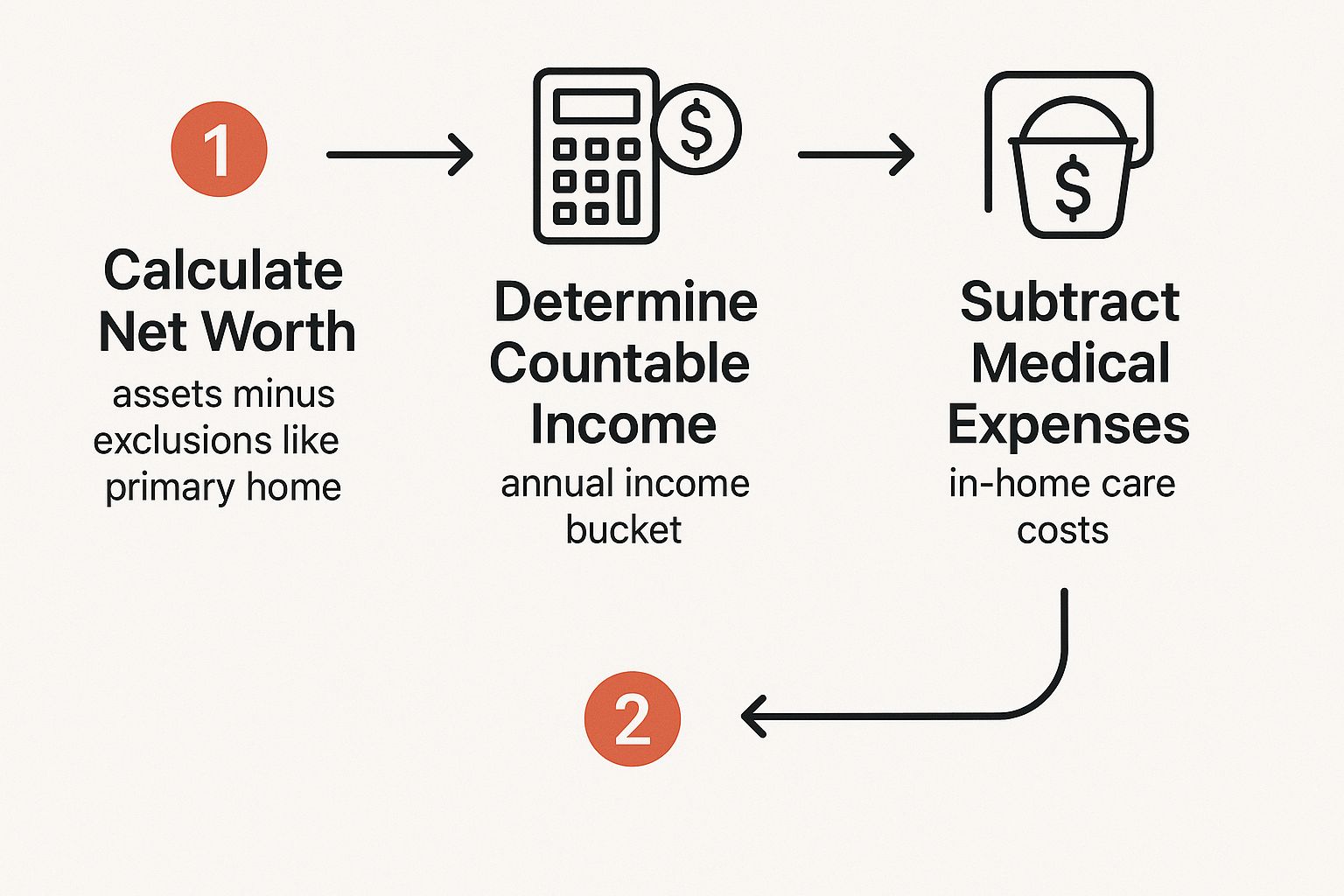
This visual breaks down the simple, three-step process the VA uses. They start with your net worth, then subtract your medical expenses to figure out your true eligibility. As you can see, the key to qualifying often comes down to knowing exactly what you can legally deduct from your income.
What Is Your Net Worth?
Your net worth is the total value of your assets combined with your annual income. For 2025, the VA has set the net worth limit at $159,240. If you fall below this number, you’ve cleared the first financial hurdle.
But here’s the good news: not everything you own gets counted toward that limit. The VA makes some really important exclusions to help veterans qualify.
Assets that are NOT counted toward your net worth include:
- Your primary home (the one you live in).
- Your personal vehicle.
- Most of your everyday household goods and furniture.
This is a critical point that trips people up. I’ve seen families in Vienna or Alexandria assume that owning a home automatically disqualifies them, but that's just not the case. The VA is much more concerned with liquid assets—things like stocks, bonds, and savings accounts.
How Countable Income Changes Everything
The second bucket is your countable income, and this is where the real opportunity is, especially for anyone who needs in-home care. Your countable income isn't your gross annual income. It's your gross income minus certain allowable deductions—most importantly, your unreimbursed medical expenses.
This is the single most important concept in the financial eligibility puzzle. High medical costs, including the expense of professional in-home care, can significantly reduce your "countable" income, often bringing it below the VA's limit even if your gross income seems too high at first.
The Aid and Attendance benefit has long been an essential lifeline for veterans and their families. To make sure it keeps up with rising healthcare costs, the VA adjusts the benefit amounts from time to time. For example, in 2025, the maximum monthly benefit for a single veteran is $2,358, which is an increase from $2,300 in 2024. A quick look at the latest VA pension rates shows how these adjustments reflect the ongoing need for this support.
This is where hiring an agency like Caring Senior Service becomes so valuable. The documented costs of our in-home care services can be used as a medical expense deduction. If you want to get a better sense of these expenses, you can learn more about the average costs of senior care in our area. For many veterans, this strategic deduction is the very key that unlocks their eligibility, allowing them to use their hard-earned benefits to pay for the care they need to thrive at home.
Proving Your Medical Need for Assistance
Once you've cleared the service and financial hurdles, you get to the real heart of the matter: proving a clear, medical reason for needing daily support. This isn't just about having a specific diagnosis. It’s about showing the VA, in no uncertain terms, how a medical condition makes it unsafe or impossible to get through the day alone. They need to see it on paper.
The key piece of evidence here is usually a formal statement from a doctor, often on VA Form 21-2680. This is where your physician details exactly why you or your spouse can't manage daily life without someone's help. The doctor has to certify that the applicant needs regular assistance with their Activities of Daily Living (ADLs) or is in a care facility because of a physical or mental impairment.

What Are Activities of Daily Living?
Activities of Daily Living, or ADLs, are the basic, essential tasks of self-care. Think of them as the building blocks of an independent day. Generally, the VA wants to see that help is needed with at least two of these ADLs. And "needing help" doesn't always mean someone has to do it for you; it can simply mean you need someone standing by to prevent an accident, such as a fall.
- Bathing and Hygiene: Help with washing, getting the water temperature right, or just having someone in the room for safety.
- Dressing: Support with buttoning a shirt, tying shoes, or managing supportive braces.
- Eating: This specifically means help with the physical act of feeding, not just preparing meals.
- Toileting: Assistance getting on or off the toilet and managing incontinence.
- Mobility (Transferring): Help moving from a bed to a chair, getting in and out of a car, or safely navigating stairs.
As you consider how to demonstrate this need, it's helpful to know what kind of support is out there. This comprehensive guide on mobility aids and patient safety technology is a great resource and can highlight the level of assistance someone truly requires.
Cognitive Impairment as a Qualifying Factor
It’s not just about physical limitations. Cognitive issues like dementia or Alzheimer's are major qualifying factors. If a veteran needs supervision to stay safe from everyday dangers—like wandering off or forgetting to take their medicine—that absolutely constitutes a need for "aid and attendance."
Documenting these cognitive challenges is every bit as critical as proving physical needs. If you're seeing changes in a loved one, learning about the early signs of memory loss can help you have a more informed conversation with their doctor.
At Caring Senior Service of Arlington, our GreatCare™ method starts with a detailed in-home assessment. We look at a senior’s specific needs related to these very ADLs, building a Customized Care Plan that perfectly mirrors the kind of evidence the VA is looking for. This makes the journey from assessment to application so much smoother for families in McLean, Springfield, and across Northern Virginia.
Common Application Myths and Mistakes
Misinformation about VA Aid and Attendance eligibility is a huge roadblock, and frankly, it keeps deserving families from even trying to apply. I've heard from so many veterans and spouses in Great Falls and Annandale who assume they won’t qualify because of rumors or things they heard years ago. It’s time to set the record straight.
One of the most persistent myths I hear is that a veteran had to have served in combat to be eligible. That's just not true. The key is active duty service during one of the VA's designated wartime periods—it doesn't matter one bit where the veteran was stationed.
Another big one is the belief that owning a home or having some savings automatically disqualifies you. The VA doesn’t count your primary residence or your car as part of your net worth. More importantly, it looks at your countable income, which is your gross income minus your unreimbursed medical expenses. Think of things like the cost of professional in-home care—those costs are deducted.
Frequent Application Pitfalls
Beyond the myths, simple mistakes on the application itself can cause major delays or even get your claim denied. Knowing what these common errors are ahead of time can help you put together a much stronger, more accurate claim right from the start.
- Incomplete Forms: Every single question on the required VA forms needs an answer. If you leave fields blank, the VA will likely send the application back, and you'll lose your place in the processing queue.
- Weak Medical Evidence: A vague doctor’s note just won't cut it. A frequent mistake I see is submitting a note that doesn't specifically detail why help is needed with Activities of Daily Living (ADLs). The medical evidence has to clearly and medically justify the need for daily assistance.
- Poor Financial Documentation: If you don't properly document all your medical expenses, you can’t reduce your countable income enough to qualify. You need to keep detailed records of every single cost, from caregiver invoices to prescription co-pays.
The VA has a massive backlog of pending claims, which means any mistake, no matter how small, can add months to your wait time. Taking the time to double-check every detail and gather strong, clear evidence is truly the best way to avoid frustrating and unnecessary delays.
Using In-Home Care to Qualify and Thrive
This is where all the pieces of the VA Aid and Attendance eligibility puzzle really come together. For many veterans, the cost of professional in-home care is the very key that unlocks their benefits, creating a practical plan for long-term well-being. It’s a powerful strategy that turns a medical necessity into a financial solution.
The logic is refreshingly straightforward: the VA lets you deduct unreimbursed medical expenses from your income. When you hire a professional agency like Caring Senior Service of Arlington, the documented cost of that care becomes a major medical deduction. More often than not, this is what lowers a veteran's "countable income" below the VA's threshold, making them eligible.

Creating a Sustainable Care Cycle
Once your application gets the green light, the VA pension funds are paid directly to you. You then use that monthly payment to cover the costs of the exact in-home care services that helped you qualify in the first place.
This creates a self-sustaining cycle of care that works like this:
- Assess Need: We work with you to create a customized care plan that addresses your specific daily challenges.
- Deduct Costs: The documented cost of this care plan is used to reduce your income for the VA application.
- Receive Benefits: Once approved, you start receiving a monthly pension.
- Fund Care: You use the pension to pay for the essential in-home care, allowing you to thrive safely at home.
This isn't some kind of loophole; it’s exactly how the benefit is designed to function. It ensures that veterans who need daily support have a clear and practical way to afford it.
Thriving at Home with GreatCare™
Our GreatCare™ method is all about providing quality caregivers who help veterans across Northern Virginia live safely and with dignity. From hands-on assistance in Arlington to companion care in Fairfax, our team provides the support needed to age in place comfortably.
Many veterans use their benefits not just for personal care, but also to make sure their environment is safe. For more on that, take a look at these essential home modifications for elderly safety and comfort.
When you partner with us, you get more than a caregiver; you get peace of mind. Knowing a dedicated professional is there provides immense relief for families. If you’re ready to see how our services can make a difference, you can learn how to start the home care process with us today.
Answering Your Top Eligibility Questions
When families start looking into VA Aid and Attendance eligibility, a lot of questions come up. It's a complex benefit, and it's easy to get lost in the details. Let's walk through some of the most common questions we hear from families here in Northern Virginia and get you some clear, straightforward answers.
How Long Does the Application Process Take?
There's no single answer here, but you can generally expect a decision from the VA to take anywhere from a few months to over a year. The biggest thing you can control in this process is how you file your initial claim. Submitting a complete, well-documented application from the very beginning is the absolute best way to keep things moving and avoid those frustrating, unnecessary delays.
Can a Surviving Spouse of a Veteran Qualify?
Yes, they absolutely can. The Aid and Attendance benefit isn’t just for veterans. A surviving spouse is eligible as long as two important conditions are met. First, the deceased veteran had to have met the VA’s wartime service requirements. Second, the surviving spouse must meet the current medical and financial criteria on their own.
A common misconception is that the benefit is only for the veteran. The VA recognizes the sacrifices of military families, and this pension is a critical lifeline for many surviving spouses who need care.
What Kind of Caregiver Is Required to Use the Benefit?
This is a really important point. The VA pays the benefit directly to you, but to keep your eligibility, they need clear proof that you're spending that money on care. Simply paying a family member or neighbor in cash usually doesn't cut it. The VA is looking for formal documentation, which informal arrangements often can't provide.
Using a professional, licensed home care agency like Caring Senior Service is the most straightforward way to meet this requirement. We provide:
- A formal service contract that clearly outlines the care you're receiving.
- Detailed invoices that serve as official proof of your medical expenses for the VA.
- Trained, vetted caregivers who deliver high-quality, reliable support you can count on.
This professional documentation takes the guesswork out of the process, ensuring your records meet VA standards and giving you total peace of mind.
At Caring Senior Service of Arlington, we help seniors across Northern Virginia remain safe, healthy, and happy at home. Call us at (571) 202-6522 to schedule a free consultation today.