
Key Takeaways
- 4 in 10 adults aged 45 and older now report feeling lonely, up from 1 in 3 in 2018, and seniors living alone face the highest rates
- Social isolation carries health risks equivalent to smoking 15 cigarettes a day and raises dementia risk by approximately 27%
- Arlington County is home to roughly 28,500 residents aged 65 and older, and local programs like the Shepherd’s Center of Northern Virginia offer free volunteer companion visits
- Companion care is non-medical: a trained caregiver provides conversation, activities, and regular visits to reduce isolation, no clinical background needed
- Warning signs include withdrawing from hobbies, stopped phone calls, skipping meals, and flat affect during family visits
- Companion care can be scheduled as a standalone service or combined with transportation, meal preparation, and other support under one hourly rate
Companion care for seniors in Arlington, VA provides regular in-home social engagement, conversation, shared activities, and outings, through a trained caregiver who helps older adults who live alone reduce isolation and stay mentally connected in Northern Virginia.
If your parent has grown quieter over the past year, you’re probably not imagining it. Loneliness is one of the most underestimated risks in aging, and it’s far more common in Arlington than most families realize.
The Health Toll of Senior Loneliness Is Larger Than Most Families Expect
Loneliness isn’t just emotional discomfort. Researchers now classify it as a physical health risk on par with smoking.
The health effects of prolonged social isolation are equivalent to smoking 15 cigarettes a day, according to the National Council on Aging. That’s not a figure most families expect to hear. It changes how urgently you should act on a parent who’s been withdrawing over the past year.
The risks compound from there. Older adults who are socially isolated face approximately a 27% higher risk of developing dementia compared to those with regular social contact. Research published through the University of Michigan also found that adults 50 and older who report persistent loneliness face a 25% higher stroke risk than those who are not lonely.
These aren’t soft findings. They come from longitudinal studies tracking tens of thousands of older adults over years.
How widespread is the problem? AARP’s 2025 loneliness research found that 4 in 10 U.S. adults aged 45 and older now report feeling lonely, up from 35% in both 2010 and 2018. Among those reporting fair or poor physical health, the rate climbs to 53%.
Arlington County has roughly 28,500 residents aged 65 or older, based on U.S. Census Bureau estimates. Many live alone. For a significant share of them, the primary unmet need isn’t medical, it’s human contact.
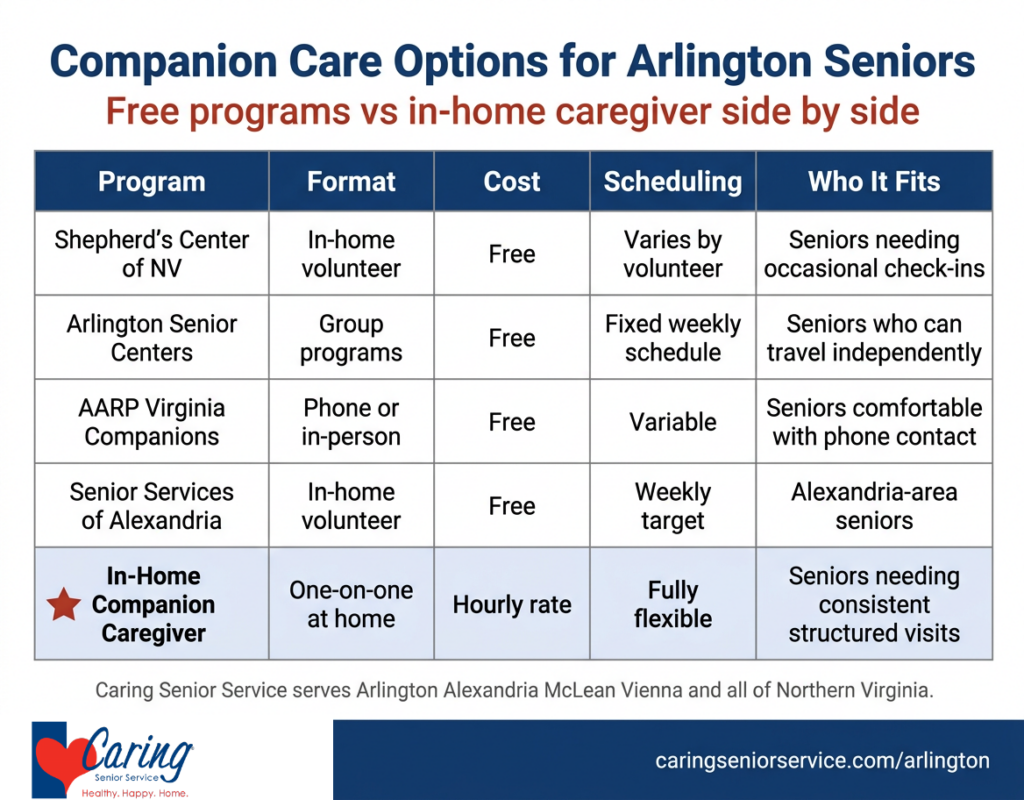
Signs Your Parent May Be Becoming Isolated
Social withdrawal is easy to explain away. Families do it all the time, “she’s just an introvert,” “he’s always been quiet.” But isolation has specific behavioral patterns worth recognizing.
Signs of social isolation in seniors:
- Stopped returning calls, or picks up but ends conversations quickly
- No longer mentions friends, neighbors, or regular activities
- Quit a hobby, group, or weekly routine without explanation
- Skips meals or eats alone with no interest in the food
- Seems flat or disengaged during visits, noticeably different from their baseline
- TV has become the primary daily activity
- Grooming or home upkeep has declined without a physical cause
None of these signals a crisis on its own. But three or four of them together, especially appearing over a few months, usually indicates something real.
The adult children who call us most often describe the same pattern: “I noticed it gradually, then all at once.” If that’s where you are, it’s worth taking the next step.
Arlington Programs That Can Help – And Where Each One Fits
Arlington has real local programs designed to address senior loneliness. These are worth knowing about before considering private care.
Shepherd’s Center of Northern Virginia
Based in McLean and serving the Arlington area, the Shepherd’s Center runs a companion visitor program pairing volunteers with seniors for regular in-home or phone check-ins. Volunteers are vetted and trained. Availability varies by the volunteer pool at any given time.
Arlington Senior Centers, Walter Reed and Langston-Brown
The Walter Reed Community Center and Langston-Brown Community Center run ongoing programming for seniors, fitness classes, social groups, educational events, and drop-in lunches. These work well for seniors who can travel independently and are motivated to go out.
AARP Virginia Volunteer Companions
AARP Virginia coordinates companion programs through local chapters, offering phone or in-person visits from community volunteers.
Senior Services of Alexandria, Friendly Visitor Program
For seniors in Old Town Alexandria and surrounding areas, Senior Services of Alexandria runs a Friendly Visitor program pairing trained volunteers with isolated seniors in their homes. Seniors interested in volunteer opportunities in Old Town Alexandria can also connect with this program from the giving side.
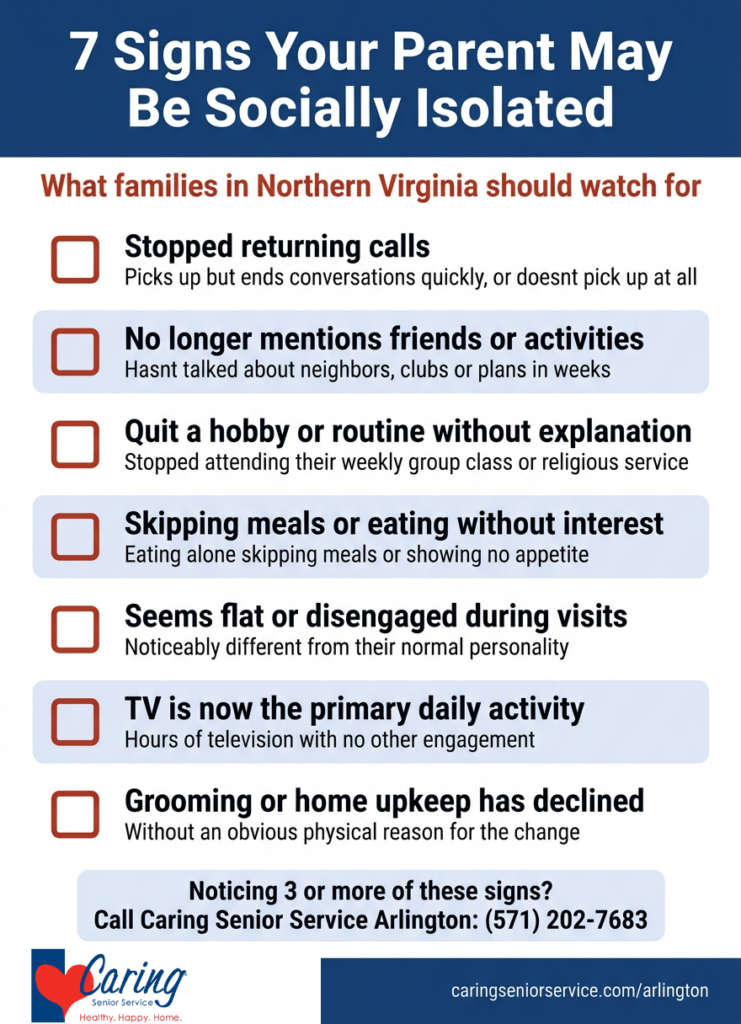
Here’s how the main options compare:
| Program | Format | Cost | Scheduling | Coverage |
|---|---|---|---|---|
| Shepherd’s Center of Northern Virginia | In-home volunteer visits | Free | Varies by volunteer | McLean / Arlington area |
| Arlington Senior Centers | Group programming | Free | Set weekly schedule | Must travel to center |
| AARP Virginia Companions | Phone or in-person | Free | Variable | Virginia-wide |
| Senior Services of Alexandria | In-home volunteer | Free | Weekly target | Alexandria focus |
| In-home companion caregiver | In-home one-on-one | Hourly rate | Fully flexible | Arlington + all of NoVA |
Free programs are genuinely valuable. But they all depend on volunteer availability and fixed scheduling. A senior who needs consistent, several-times-weekly contact often needs something more structured, which is where private companion care fills the gap.
What In-Home Companion Care for Seniors Actually Covers
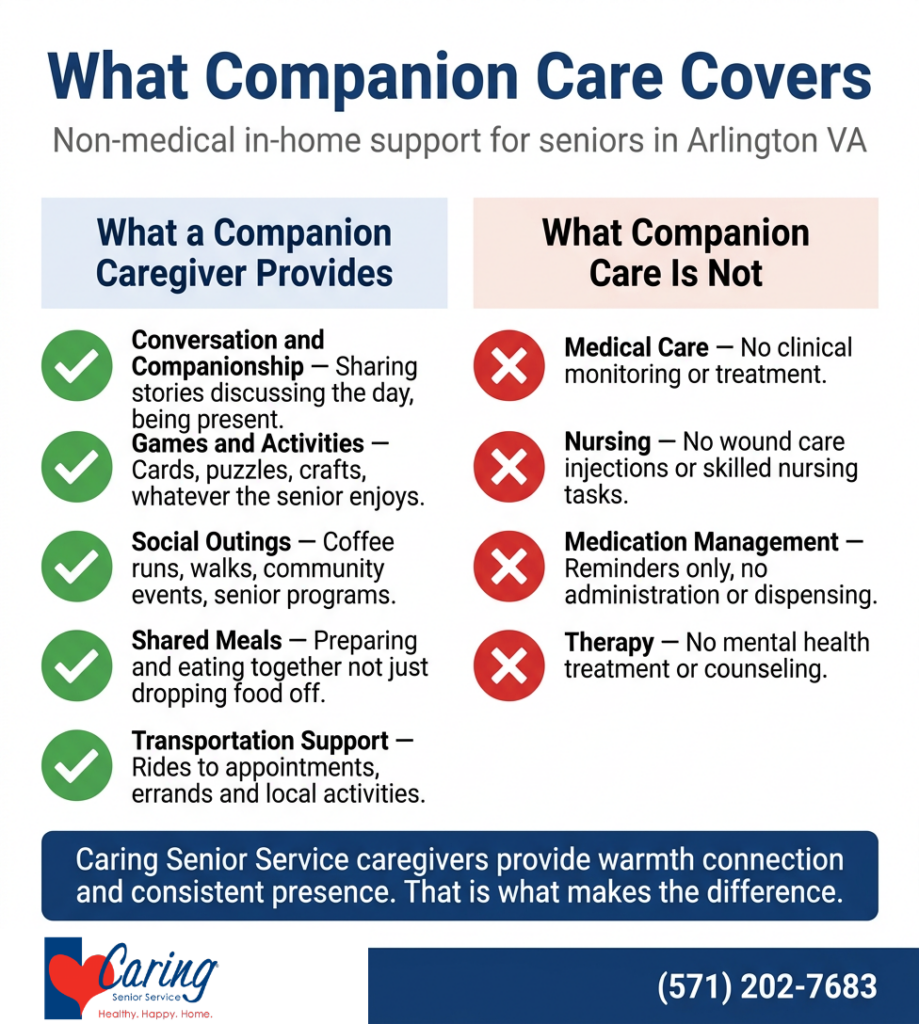
Companion care is non-medical in-home support focused on social engagement and emotional wellbeing. A companion caregiver isn’t a nurse or a therapist. They’re a consistent, trusted presence, someone who shows up reliably and genuinely cares about the person they’re with.
What does a typical caregiver visit include?
- Conversation – talking through the day, sharing stories, discussing news, books, or memories
- Activities and games – card games, puzzles, crafts, or whatever the senior enjoys and will actually do
- Social outings – a trip to senior-friendly activities in the area, a walk, a coffee run, or attending a community event together
- Shared meals – preparing and eating together, not just setting food on the table and leaving
- Engagement support – helping a senior stay motivated to attend senior social groups or local learning programs they’ve started avoiding
What companion care is not:
- Medication administration or clinical monitoring
- Skilled nursing or any wound care
- Therapy or mental health treatment of any kind
Caregivers provide warmth and connection. Families consistently tell us that’s often the thing that makes the biggest difference – not the logistics, but the fact that someone is genuinely there.
Combining Companion Care With Other Support
For many seniors, companion care is the first step into a formal care relationship. It requires no medical assessment and no clinical justification. You schedule visits, and the care plan adjusts as needs change.
If your parent also needs help getting to senior activities in Arlington, the same caregiver can handle transportation. If meals have become a concern, caregivers prepare and eat those meals together during the visit. All services run at one flat hourly rate, no separate fees for companion time versus transportation versus errand help.
For family members managing care from a distance, companion care also works as respite support, a trusted caregiver steps in so family doesn’t have to be present every day. And for caregivers who need a break without worrying about what’s happening at home, the Family Portal tablet every CSS client receives lets you stay informed in real time.
Every new care relationship at Caring Senior Service starts with a 43-point home safety assessment. This often surfaces things families have missed, fall hazards, lighting issues, and other risks that become more serious when a senior spends long periods alone. It’s included at no extra charge.
If you’re noticing the signs and aren’t sure what to do next, the right first step is a conversation, not a commitment. Call Caring Senior Service of Arlington at (571) 202-7683. We’ll tell you honestly whether companion care is the right fit and walk you through what getting started looks like.
Frequently Asked Questions
Q: What does a companion caregiver do for a senior in Arlington, VA?
A: A companion caregiver provides regular in-home visits focused on social engagement, conversation, shared activities, games, outings, and meals together. They don’t provide medical care, nursing, or therapy. For seniors in Arlington, companion care services can also include transportation to local programs, parks, and community events.
Q: How often does a companion caregiver visit?
A: Visit frequency depends on the senior’s situation and the care plan. Some families start with two or three visits per week; others schedule daily contact. There’s no required minimum, the schedule adjusts to what actually works for the senior and the family.
Q: Is companion care covered by insurance in Virginia?
A: Major medical insurance and Medicare don’t typically cover non-medical companion care. Long-term care insurance policies often do. VA Aid & Attendance benefits can also be applied toward companion care for eligible veterans and surviving spouses. Call the Arlington office to discuss benefit verification before assuming the full cost falls out of pocket.
Q: How is companion care different from personal care?
A: Personal care helps with physical activities of daily living, bathing, dressing, grooming, and mobility support. Companion care focuses on social and emotional engagement, conversation, outings, activities, and shared meals. Many seniors benefit from both. When the same caregiver provides both during the same visit, the transition between them is natural and the relationship stays consistent.
Sources
- AARP — Disconnected: The Escalating Challenge of Loneliness Among Adults 45-Plus (2025)
- National Council on Aging — Understanding Social Isolation and Its Impact on Older Adults
- Medical News Today — Dementia: Social Isolation May Increase Risk by 28%
- Michigan Medicine / University of Michigan — 1 in 3 Older Adults Still Experience Loneliness and Isolation
- U.S. Census Bureau — QuickFacts: Arlington County, Virginia