
When families in Arlington, VA start talking about a senior loved one’s safety at home, it can feel like walking a tightrope. You want to keep them safe, but you also deeply respect their need for independence. This is exactly where a home safety assessment for seniors comes in—not as a way to limit them, but as a tool to empower them.
The whole point is to create a supportive environment that actually enables their autonomy, rather than chipping away at it.
Think of it as a proactive check-up for the home itself. The goal is to spot and fix small hazards before they turn into big problems, allowing you and your loved one to make decisions together. This keeps them in the driver’s seat, preserving their control and confidence.
Proactive Prevention Over Reactive Crisis
It’s a mindset shift. Instead of seeing a home as a collection of potential dangers, we see it as a space that can be adapted to support a person’s changing needs. A proper assessment goes beyond the obvious, looking at everything from the lighting in a hallway to the height of the bed.
I’ve seen firsthand how this forward-thinking approach makes a real difference for families in Arlington, Vienna, and Fairfax. Key benefits include:
- Drastically Reducing Falls: Simply identifying and removing tripping hazards—like loose rugs, tangled cords, and poor lighting—can dramatically lower the risk of a fall.
- Boosting Confidence: When a senior feels safer in their home, they move around with more ease and less fear. This is huge for both their physical and mental well-being.
- Peace of Mind for Families: Knowing that your loved one’s home in Vienna or Alexandria has been thoroughly checked provides an incredible sense of relief for family caregivers.
Before we dive into the room-by-room specifics, it’s helpful to know which areas of the home typically pose the biggest risks. I’ve found that focusing on these key zones first can make the biggest impact on overall safety.
Top 5 Home Hazard Zones for Seniors
This table summarizes the most common problem areas I encounter during assessments and gives you a quick idea of where to start looking.
| Hazard Zone | Primary Risk | Example Modification |
|---|---|---|
| Bathroom | Slips and Falls | Installing grab bars in the shower and near the toilet. |
| Stairways | Trips and Falls | Ensuring handrails are secure on both sides and adding non-slip treads. |
| Kitchen | Burns and Falls | Storing frequently used items at waist level to avoid reaching or bending. |
| Bedroom | Nighttime Falls | Adding motion-sensor nightlights on the path to the bathroom. |
| Living Areas | Tripping Hazards | Securing or removing area rugs and clearing electrical cords from walkways. |
By addressing these five areas, you’re already tackling the majority of common household dangers for older adults.
Overcoming Resistance with Empathy
It’s completely normal for seniors to push back against changes that feel institutional or stigmatizing. They might worry about their home’s appearance or feel like they’re losing control over their own space. It’s a real barrier.
At Caring Senior Service of Arlington, our GreatCare™ method is built on this philosophy. We see a home safety assessment for seniors as the first step in a partnership with your family. We work with you to implement practical solutions that truly make a difference, helping seniors all across Northern Virginia stay safe and happy right where they want to be—at home.
Checking Entrances and Common Living Areas
A senior’s journey to safety begins the moment they pull into the driveway. Those first few steps from the car to the front door, and then into the main living spaces, set the tone for the entire home. Even small oversights here can create big risks. Just picture a loved one arriving home in Vienna on a rainy evening—is the path well-lit, even, and free of obstacles?
The goal is to forge a clear, welcoming, and secure path into and throughout the most-used areas of the house. This is the foundational part of any home safety assessment for seniors, and it’s where we’ll start.
Assessing Entryways for Safe Passage
The transition from outside to inside is a surprisingly high-risk moment. Your assessment needs to start before you even step through the door. Get down on their level and look for the little things that could easily cause a stumble or a serious fall.
Here are the key points I always check:
- Clear and Even Walkways: Are there cracks in the sidewalk? Uneven paving stones? Tree roots pushing up the concrete? Overgrown plants can also quickly become a tripping hazard.
- Adequate Outdoor Lighting: Make sure pathways, stairs, and especially the area around the keyhole are brightly lit. Motion-activated lights are a fantastic addition for both convenience and security.
- Sturdy Handrails: If there are steps—even just one or two—are there secure handrails on both sides? Give them a good shake to make sure they don’t wobble.
- Non-Slip Surfaces: Porches and steps get slick when they’re wet or icy. A coat of non-slip paint or some adhesive treads can make a world of difference.
Once you get to the door, check the threshold. It should be as low as possible and easy to navigate, especially for someone who relies on a walker or cane. A high threshold is notorious for catching a toe and causing a fall.
Creating Clear Pathways in Living Areas
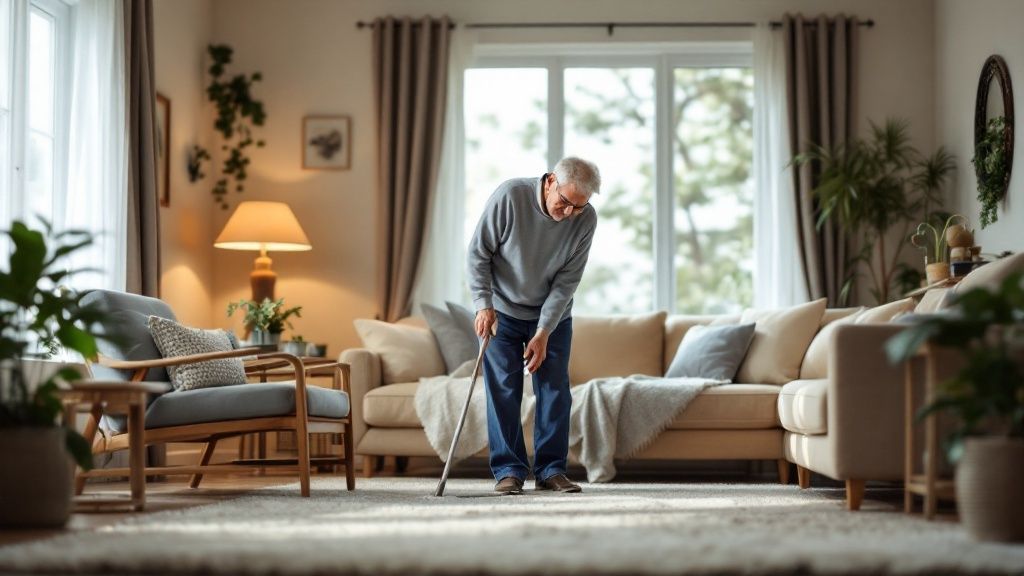
Inside, the focus shifts to creating wide, unobstructed pathways. A living room that feels cozy and lived-in to you can feel like a dangerous maze to someone with mobility challenges. For example, a senior in McLean navigating their den with a walker needs at least a 36-inch wide path to move comfortably and safely.
Start by decluttering. This doesn’t mean the space has to become sterile, but it does need to be organized. Get rid of those stacks of magazines, move unnecessary decorative items, and clear out anything else that narrows the walkway.
Next, it’s time to tackle the two most common culprits for trips and falls inside: throw rugs and electrical cords. While a beautiful rug can tie a room together, its unsecured edges are one of the most serious tripping hazards in a home.
My rule of thumb is simple: If a rug bunches up, slides around, or has curled edges, it has to go. You can try securing it with double-sided tape, but the safest option is always a clear floor.
Likewise, electrical and extension cords should never, ever run across a walkway. Reroute them along the walls or use cord covers to tack them down securely. It’s a small fix that eliminates a huge risk. And while you’re thinking about safety, consider how engaging in safe hobbies can also promote well-being. For some great ideas, check out our guide on senior activities in Arlington.
Strategic Furniture Arrangement
How furniture is placed can either help or hinder a senior’s ability to move safely. In communities from Falls Church to Alexandria, I’ve seen how a few simple adjustments can completely transform a room’s safety profile.
Here’s a quick checklist for the furniture:
- Ensure there are clear, wide paths between all major pieces of furniture.
- Check that chairs and sofas are at a height that allows your loved one to sit down and stand up easily, without straining.
- Make sure tables are stable and won’t tip over if they’re leaned on for support.
- Place frequently used items—like the remote, a phone, or a favorite book—within easy reach of their preferred chair.
The reality is, these environmental hazards are a huge concern. A recent national survey revealed that fall or slip accidents were the most common hazard seniors experienced at home, with a prevalence as high as 24.5%. Interestingly, while many seniors worry about falling, they often focus more on preventing other risks like fires or burglaries. This highlights exactly why a thorough, hands-on assessment of these everyday living areas is so critical.
Making the Kitchen a Safe and Functional Space
The kitchen is often the bustling heart of the home—a place filled with warmth, familiar smells, and cherished memories. But for seniors in Alexandria and Falls Church, it can also be a room filled with hidden risks. From hot stovetops and sharp utensils to slippery floors, a thorough kitchen evaluation is a core component of any home safety assessment for seniors.
The goal isn’t to take away the joy of cooking but to make the space more functional and far less hazardous. I’ve seen time and again how small, thoughtful changes can make an enormous difference in preventing burns, falls, and other common kitchen accidents, allowing a loved one to continue preparing meals with confidence.
Smart Organization for Easy Access
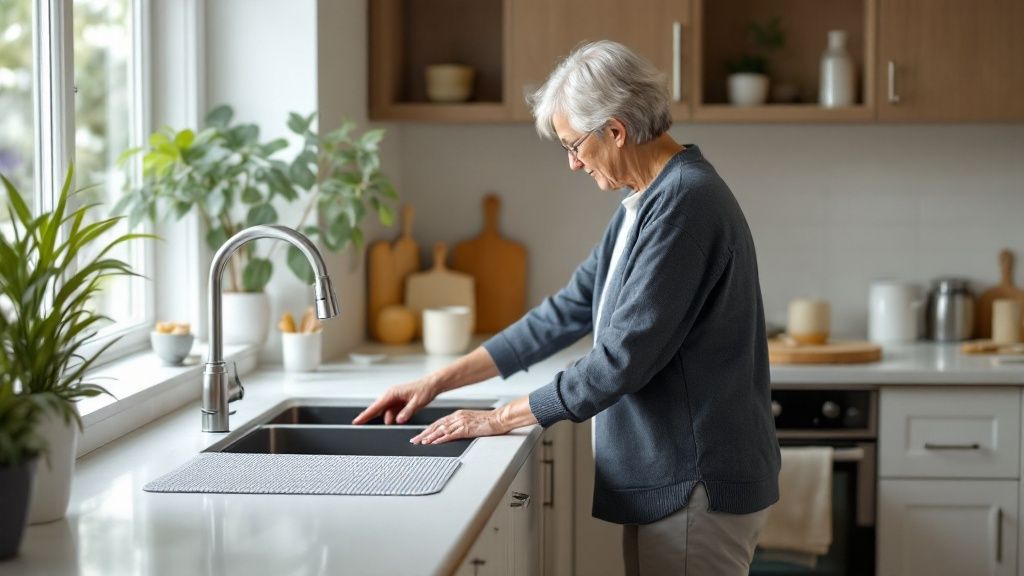
One of the biggest culprits behind kitchen mishaps is poor organization. When essential items are stored too high or too low, it forces unnecessary reaching and bending, which can easily lead to a fall. It’s all about creating what we call a “zone of functional reach.” This means keeping the items they use every single day—plates, mugs, common spices, and small appliances—on the lowest shelves of upper cabinets or the top shelves of lower ones.
- Avoid Step Stools: Reaching high or bending low dramatically increases the risk of losing balance. Rearranging cabinets to eliminate the need for a step stool is one of the most effective fall prevention strategies you can implement in the kitchen.
- Heavy Items at Waist Level: Pots, pans, and heavy mixing bowls should always be stored between waist and shoulder height. This simple change prevents the strain and instability that comes from lifting heavy objects from the floor or pulling them down from above.
- Consider Pull-Out Shelves: Installing pull-out shelving in lower cabinets can be a complete game-changer. It makes it easy to see and retrieve items from the back without deep bending or kneeling.
Appliance and Fire Safety Checks
Appliances are central to any kitchen, but they also represent significant fire and burn risks if they aren’t managed properly. When you’re doing an assessment, pay close attention to the details of each appliance your loved one uses.
Start with the stove. Are the knobs clearly marked with “On” and “Off” positions? Faded markings are a common problem and can lead to a burner being left on accidentally. For seniors with memory issues, you might want to consider automatic stove shut-off devices that can be programmed to turn off after a set period of time.
Next, check the microwave. It should be placed at counter height—not too high and not too low—to prevent dangerous spills of hot food. Make sure the controls are simple and easy to read, as complex digital panels can be confusing and frustrating.
A critical but often overlooked fire safety step is cleaning the exhaust fan filter above the stove. A greasy, clogged filter is a significant fire hazard. It absolutely should be cleaned regularly to prevent grease buildup.
Finally, make sure a small, easy-to-use fire extinguisher is stored in an accessible location, and that your loved one knows how to operate it. Don’t forget to check that the smoke and carbon monoxide detectors are functioning correctly with fresh batteries.
Lighting and Flooring for a Safer Kitchen
Good lighting is completely non-negotiable in a kitchen. Dimly lit countertops make it difficult to see while chopping vegetables or reading recipes, increasing the risk of cuts and other mistakes. The best solution I’ve found is to install bright, under-cabinet lighting that directly illuminates the primary work surfaces.
The floor is another major consideration. Spills are just a fact of life in a kitchen, turning a standard floor into a slick hazard in seconds.
- Always clean up spills immediately.
- Use non-slip mats with rubber backings in front of the sink and stove, where water or grease is most likely to splash.
- Ensure there are no curled edges on any mats that could become a tripping hazard.
Maintaining a clean and clutter-free kitchen is an ongoing task that directly contributes to safety. As part of our GreatCare™ promise, our Quality Caregivers can assist with these daily tasks, ensuring the kitchen remains a safe and pleasant space. You can learn more about how we help by exploring our light housekeeping services that support seniors throughout Northern Virginia.
Securing the Bathroom to Prevent Falls
If there’s one room in the house that gives families the most anxiety, it’s the bathroom. Statistically, it’s one of the most hazardous spots for older adults. You’ve got hard surfaces, water, and tight spaces—a perfect storm for slips and falls. This is why a thorough bathroom check is ground zero for any home safety assessment for seniors.
Transforming this space isn’t about taking away independence; it’s about making smart, empowering upgrades. With a few key modifications, families in Northern Virginia can help their loved ones navigate their daily routines with much more confidence. The goal is to turn a source of worry into a safe haven.
This visual guide breaks down a clear process for boosting bathroom safety.
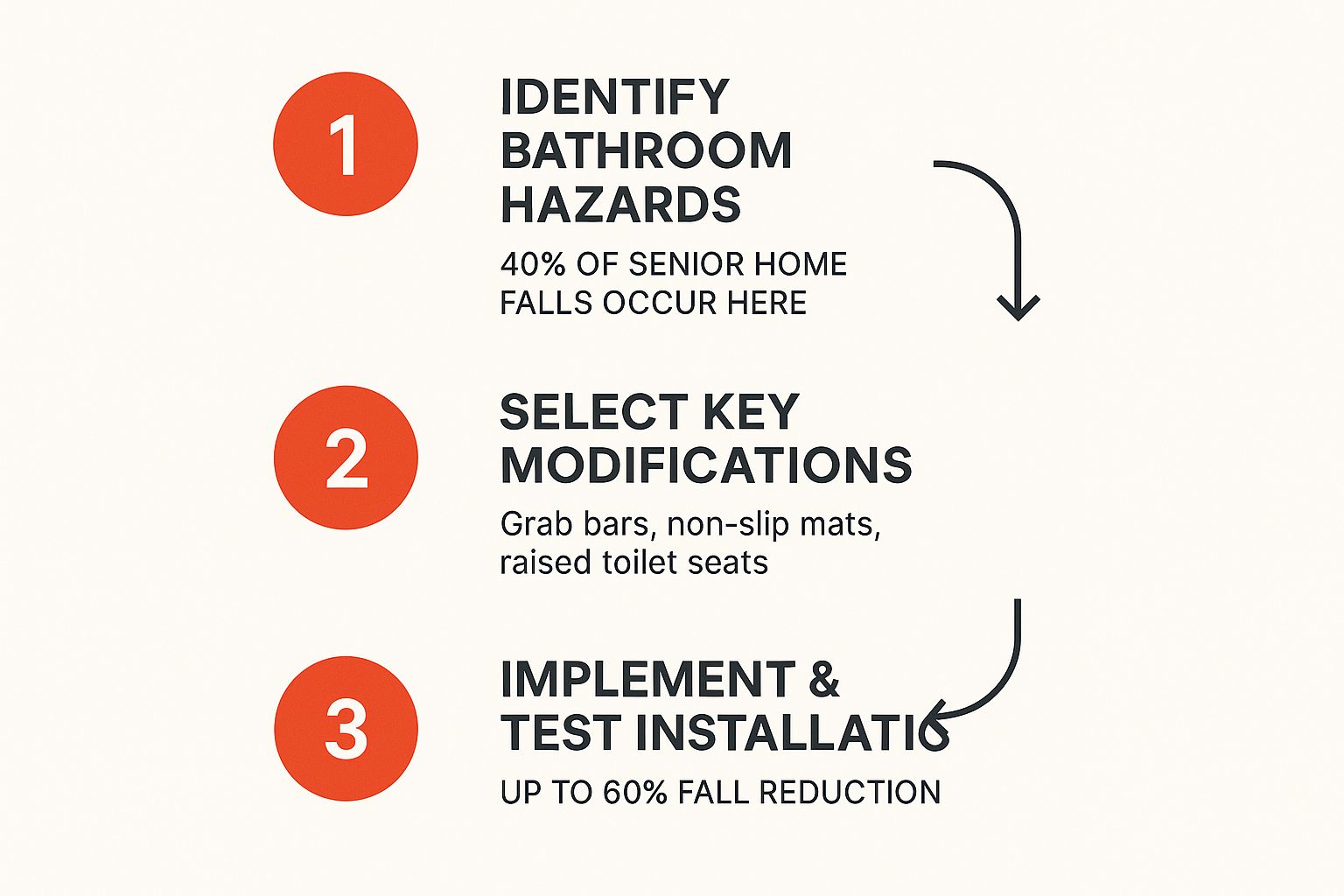
As you can see, a systematic approach—spotting the hazards, picking the right fixes, and getting them installed properly—can drastically cut down on fall risk. It proves that targeted changes in high-risk areas like the bathroom really do deliver the biggest safety payoff.
Installing Essential Stability Aids
The single most effective safety addition you can make to a bathroom is installing properly secured grab bars. And let me be clear: these are not the same as towel racks. A towel rack is not designed to support a person’s weight and can rip right out of the wall when you need it most.
From my experience, I always recommend placing grab bars in these key locations:
- Inside the Shower: A vertical bar near the entrance is a game-changer for stepping in and out. Add a horizontal bar on the long wall for stability while washing.
- Next to the Toilet: A grab bar here offers crucial support for sitting down and standing back up. These are two moments when balance is incredibly precarious.
Beyond grab bars, a shower chair or bench is another fantastic tool. It gives a senior a secure place to sit, which cuts down on fatigue-related falls. Standing on a wet, slippery surface for a long time is exhausting and risky; this simple addition solves that problem.
Many families I work with in Arlington and Alexandria are stunned by how much of a difference these simple items make. A shower chair isn’t just a safety device; it’s a tool that conserves energy and makes daily hygiene a much less intimidating task.
Addressing Floor and Water Hazards
Once you’ve handled stability, the floor is your next priority. Bare tile or vinyl becomes incredibly slick the second it gets wet. Your best defense is a high-quality, non-slip bath mat, both inside the tub or shower and on the floor just outside of it. Look for mats with strong suction cups or a rubberized backing that won’t budge.
Another hazard that often gets overlooked is the water temperature itself. A senior’s skin can be more sensitive, and their reaction times might be slower, which dramatically increases the risk of serious scalds from water that is too hot.
- Set the home’s water heater to a maximum temperature of 120 degrees Fahrenheit. It’s a simple adjustment that provides a safe, comfortable temperature and virtually eliminates the risk of accidental burns.
Improving Visibility and Accessibility
Poor lighting can make a familiar bathroom feel like a maze, especially for those late-night trips. You need bright, even lighting. Think about installing a brighter main fixture and adding a plug-in nightlight to illuminate the path from the bedroom to the bathroom.
Finally, take a look at where everything is stored. Are essential items easy to reach? Soap, shampoo, and towels should be accessible without any risky bending or stretching. A simple shower caddy or a low, stable shelf can fix this instantly. All these thoughtful modifications work together to create a bathroom that is not just safer, but far more comfortable and user-friendly for your loved one.
Improving Safety in Bedrooms and Hallways
The bedroom should be a sanctuary, a place of rest and comfort. But for many seniors, it’s also the starting point for one of the most hazardous trips in the home: the nighttime journey to the bathroom. Navigating dark hallways while still groggy from sleep presents a unique set of challenges. This is why a huge part of any home safety assessment for seniors has to focus on the path from the bed to the bathroom.
The good news is that simple, often low-cost adjustments can dramatically reduce the risk of a fall. It’s all about creating a safe, well-lit, and completely unobstructed route for your loved one.
Creating a Safe Zone Around the Bed
Bedroom safety starts in the immediate area around the bed. This is the first and last place your loved one interacts with each day, so it has to be secure and functional.
One of the first things I check is the bed height. When your loved one sits on the edge, their feet should be flat on the floor, with their knees bent at a comfortable 90-degree angle. A bed that’s too high or too low can make getting in and out an unstable, strenuous task.
Next, let’s look at the bedside table. It needs to be stable and within easy reach from bed. Think of this table as the command center for nighttime needs. It should securely hold essentials like:
- A lamp that’s easy to turn on without fumbling in the dark.
- A telephone or a charged cell phone.
- A glass of water.
- Eyeglasses.
Illuminating the Path Forward
Once the bedside is secure, the next priority is lighting the way. I’ve seen countless situations where poor visibility was the direct cause of a nighttime fall, and it’s one of the easiest hazards to fix.
Motion-activated nightlights are a fantastic and affordable solution. Placing them along the floorboards in hallways, the bedroom, and the bathroom creates an automatic, illuminated pathway the moment your loved one gets out of bed. This completely eliminates the need to search for light switches in the dark—a common moment for disorientation and loss of balance.
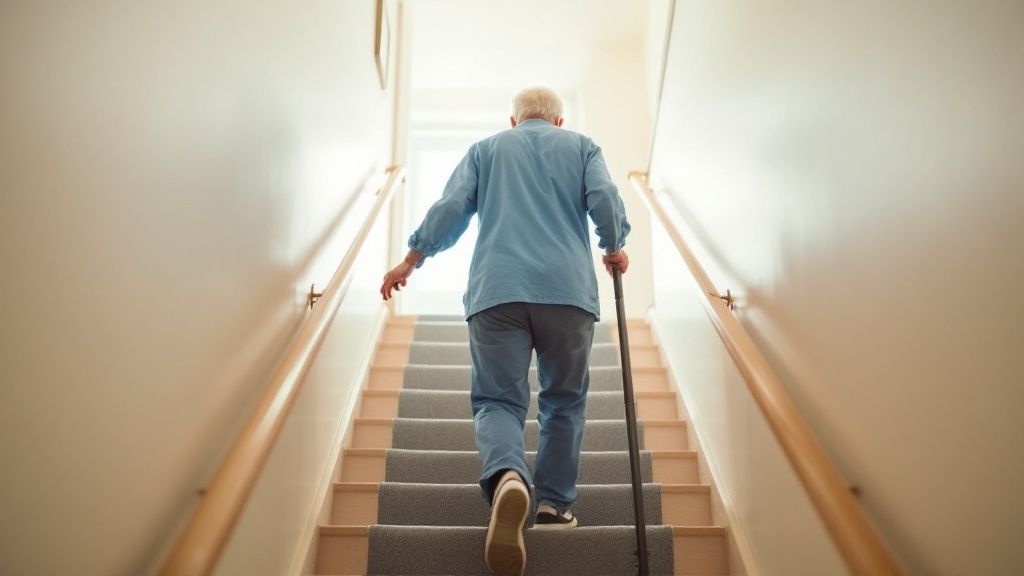
Ensuring there’s a light switch at both the top and bottom of any staircase is another critical lighting update. This prevents a senior from ever having to navigate stairs in the dark, which is one of the highest-risk activities in a home.
Clearing Hallways and Ensuring Clear Passage
A hallway should be a clear and open thoroughfare, not an obstacle course. During your assessment, physically walk the path from the bedroom to the bathroom and look for anything that could cause a trip.
Remove all clutter, including decorative items, stacks of mail, or stray shoes. Pay special attention to throw rugs. In my experience, their tendency to bunch up or slide makes them a serious, unnecessary hazard. It’s always safest to have a clear, non-slip floor surface.
When you’re doing a home safety assessment for seniors, it helps to know which fixes you can tackle yourself and when it’s time to call in a pro. Here’s a quick breakdown to help you prioritize and budget.
Low-Cost vs. Professional Home Safety Modifications
| Safety Modification | Typical DIY Cost | When to Call a Professional | Primary Benefit |
|---|---|---|---|
| Install Nightlights | $20 – $50 | Rarely needed | Prevents nighttime falls by improving visibility. |
| Secure Rugs with Tape | $10 – $20 | If flooring needs repair | Reduces immediate tripping hazards from rugs. |
| Install Handrails | $50 – $150 | For secure wall mounting | Provides crucial support in long hallways or stairs. |
| Add Light Switches | $150 – $300+ | Always (for electrical work) | Ensures safe lighting control at all entry/exit points. |
Making these adjustments in the bedroom and hallways does more than just prevent falls; it provides a profound sense of security. It empowers seniors in Arlington and across Northern Virginia to move about their own homes with confidence, at any hour of the day or night.
How Professional Caregivers Enhance Home Safety
Making physical changes to a home is a great start, but a true home safety assessment for seniors is never a one-and-done task. It highlights the need for ongoing watchfulness, and that’s where the human element becomes so important. A professional caregiver from Caring Senior Service of Arlington is more than just a visitor; they become a dedicated safety partner, providing a continuous layer of support that structural changes simply can’t match.
This dynamic approach to safety is a cornerstone of our GreatCare™ methodology. It’s not just about providing companionship. It’s about having a trained professional who gets to know your loved one’s specific home environment and daily rhythms, bringing a fresh, knowledgeable perspective to everyday life.
The GreatCare Method in Action
Our GreatCare™ method is built on three pillars: Quality Caregivers, Customized Care Plans, and Active Involvement. Our caregivers are trained to spot the subtle but significant safety issues that can pop up without warning. This kind of proactive observation is what helps prevent accidents before they ever have a chance to happen.
Here’s what this actually looks like for a senior living in Arlington or Alexandria:
- Observing Daily Routines: A caregiver might notice that a senior consistently seems unsteady in the afternoon. This simple observation could lead to suggesting a scheduled rest period or a snack to help stabilize blood sugar.
- Assisting with High-Risk Tasks: They provide steady, hands-on support during activities like bathing and dressing—two of the most common times for falls to occur.
- Ensuring Medication Adherence: Getting medications right is a huge part of in-home safety. Our caregivers are there to make sure doses are taken correctly and on schedule, preventing dangerous mix-ups.
This level of detailed, daily attention goes far beyond what a one-time assessment can accomplish. It creates a responsive safety net that adapts as a senior’s needs change.
Active Involvement and Family Communication
A key part of our GreatCare™ method is Active Involvement. We know that families need—and deserve—to be kept in the loop. Our caregivers maintain consistent communication, providing you with updates on safety observations or any changes in your loved one’s condition. If a new tripping hazard appears or a lightbulb burns out in a crucial spot, you’ll be the first to know.
This partnership provides immense peace of mind. It means someone is always there, not just as a helper, but as an advocate for your loved one’s well-being.
The focus on home care safety for older adults has grown significantly, which really underscores its importance. Between 2009 and 2019, the annual number of research publications on this topic nearly quadrupled, highlighting just how much of a global priority creating safe, independent living environments has become. You can learn more about these findings on home care safety to see how this trend is shaping modern care.
We believe this kind of professional oversight is a vital part of any comprehensive safety plan. Of course, understanding the financial side is important, too. We invite you to read our guide on senior care costs to see how this care can fit into your family’s budget.
Have Questions About Senior Home Safety? We Have Answers
Even after walking through a home room by room, families usually have a few lingering questions about making it all happen. It’s completely normal. We get these questions all the time, so let’s tackle some of the most common ones we hear when conducting a home safety assessment for seniors.
How Often Should We Re-Evaluate the Home?
Think of a home safety assessment as an annual check-up. A thorough walkthrough should be done at least once a year.
However, life happens. It’s absolutely crucial to reassess the home after any major health event—a fall, a new diagnosis, or a stay in the hospital, such as a discharge from Inova Fairfax Hospital or Virginia Hospital Center. As a loved one’s health or mobility changes, their environment needs to change right along with them.
My Parents Are Resistant to Changes. Where Do I Even Start?
This is probably the most common hurdle families face, and it’s completely understandable. No one likes to feel like they’re losing their independence. The best way to approach this is to frame the conversation around preserving that independence, not taking it away.
Talk about modifications as “upgrades” that make life easier and more comfortable, not as signs of weakness or inability. Sometimes, the easiest path is to start small with less obvious changes, which helps build trust for bigger modifications later.
Bringing in a neutral third party, like a professional from Caring Senior Service of Arlington, can also make a world of difference. An expert opinion often feels less personal and more objective, making the recommendations easier for everyone to accept.
Approaching the topic with empathy is everything. Instead of saying, “You need this grab bar,” try something like, “I was thinking this would make getting out of the shower so much easier and safer for you.” The shift from limitation to empowerment is subtle but powerful.
What’s the Single Most Important Safety Change We Can Make?
Every home has its own unique quirks and risks, but if I had to pick just one area, it would be the bathroom. Time and again, improvements here have the biggest impact on safety. The combination of water, hard tile, and porcelain surfaces makes it the highest-risk room in the house for slips and falls.
Specifically, installing properly secured grab bars in the shower and next to the toilet is the most critical modification you can make. These simple additions provide steady support during the most vulnerable moments of a senior’s day and can single-handedly prevent a life-altering injury.
Are Professional Assessments Expensive?
Many quality in-home care agencies know that a safe home is the bedrock of good care. That’s why at Caring Senior Service of Arlington, we include a comprehensive home safety assessment for seniors as a standard part of our initial consultation—which is completely free.
For families in Fairfax, McLean, and across Northern Virginia, this provides expert, personalized recommendations without any upfront cost. It’s an invaluable first step to understanding your loved one’s specific needs. Often, it sets the stage for our ongoing companionship care, ensuring that safety and well-being always go hand in hand.
At Caring Senior Service of Arlington, we help seniors across Northern Virginia remain safe, healthy, and happy at home. Call us at (571) 202-6522 to schedule a free consultation today.