

Receiving an Alzheimer’s diagnosis for a loved one is a challenge many families in Northern Virginia face. It’s a progressive brain disorder that slowly chips away at memory, thinking skills, and eventually, the ability to handle simple daily tasks. For families in Arlington, understanding what Alzheimer’s disease is marks the first step toward navigating the path ahead with confidence and compassion. It’s important to know that this isn’t a normal part of getting older; instead, it’s the single most common cause of dementia—a broader term for a decline in mental ability that’s serious enough to disrupt everyday life.
What an Alzheimer’s Diagnosis Really Means for Families
Receiving an Alzheimer’s diagnosis for someone you love can feel completely overwhelming. But understanding what the disease actually is marks the first step toward regaining a sense of control. This condition is far more than just a medical label; it’s a journey that families in Arlington, Alexandria, and across Northern Virginia navigate together, one day at a time. Many families notice changes but don’t know what steps to take next.
Think of the brain as a massive, intricate library filled with a lifetime of memories, knowledge, and skills. Alzheimer’s disease acts like a slow, persistent saboteur, quietly removing the cards from the catalog. Over time, it becomes harder and harder to find cherished memories, familiar words, or even basic instructions for daily routines.
Distinguishing Alzheimer’s From Normal Aging
One of the first and most common challenges for families is telling the difference between Alzheimer’s and typical age-related forgetfulness. It’s perfectly normal for any of us to occasionally forget an appointment or misplace our keys.
The memory loss associated with Alzheimer’s, however, is different. It’s persistent, it gets progressively worse, and it eventually begins to impact a person’s safety and independence.
The key distinction lies in the pattern and severity. Forgetting where you parked your car is one thing; forgetting how to drive or not recognizing your own car at all is another. This is the kind of reality Alzheimer’s creates.
To help clarify this crucial difference, here’s a simple comparison of common symptoms:
Alzheimer’s vs. Normal Aging Key Differences
| Symptom | Normal Aging | Potential Sign of Alzheimer’s |
|---|---|---|
| Forgetting Names | Occasionally forgetting the name of an acquaintance. | Frequently forgetting the names of close family and friends. |
| Word Finding | Sometimes having trouble finding the right word in a conversation. | Pausing or stopping mid-sentence, unable to find words; repeating stories. |
| Misplacing Items | Losing things like glasses or keys from time to time. | Putting items in illogical places (e.g., keys in the freezer) and being unable to retrace steps to find them. |
| Judgment | Making a poor decision once in a while. | Consistently showing poor judgment, especially with finances or personal safety. |
| Daily Tasks | Needing help with new technology or complex appliance settings. | Struggling with familiar, lifelong tasks like managing a budget, following a recipe, or driving to a known location. |
| Mood and Personality | Feeling irritable when a routine is disrupted. | Becoming confused, suspicious, depressed, fearful, or anxious for no clear reason. |
Hopefully, this table helps you see the patterns that signal something more serious than typical aging might be happening.
Globally, Alzheimer’s disease is the most common form of dementia, accounting for an estimated 60–70% of all dementia cases. The number of adults aged 65 and older living with Alzheimer’s and related dementias has surged by an astounding 160% over the last three decades, growing from 18.7 million cases in 1991 to 49 million in 2021.
Finding Support on Your Journey
Coping with the progressive nature of Alzheimer’s brings up profound emotions for the entire family. It’s a unique kind of loss, as you’re grieving the gradual disappearance of the person you know. Seeking professional grief counselling can provide a vital, safe space to process these complex feelings and find healthy ways to cope.
As the disease advances, the need for specialized support becomes much clearer. At Caring Senior Service of Arlington, we have dedicated programs designed to help families manage these changes with confidence and compassion. You can learn more about how our structured approach supports both seniors and their families by exploring our Dementia Guide Program.
Recognizing the Early Signs and Symptoms
The first clues of Alzheimer’s are often quiet and easy to write off as just… getting older. But telling the difference between a normal “senior moment” and something more is critical for getting support, planning for the future, and protecting your loved one’s quality of life. The changes go far beyond simple forgetfulness and start to show up in the little details of daily life, things families in communities like Fairfax or McLean might begin to notice.
It’s one thing to misplace your glasses. It’s something else entirely when your dad, a lifelong card player, suddenly can’t follow the rules of a game he’s known for decades. These are the small, confusing moments that often hint at a deeper issue.
Beyond Simple Memory Lapses
While memory loss is the symptom everyone knows, it’s the kind of memory loss that truly signals a problem. We all forget where we put our keys sometimes. But with early Alzheimer’s, a person might put their keys in the sugar bowl and have absolutely no memory of doing it. There’s no retracing their steps because the memory was never properly stored.
These aren’t just minor inconveniences; they’re disruptions that get in the way of daily living.
Some of the most common early signs that families should watch for include:
-
Difficulty with problem-solving: You might notice a loved one struggling with things that used to be second nature, like balancing a checkbook, following a familiar recipe, or keeping track of their monthly bills.
-
Challenges with familiar tasks: This can be as jarring as getting lost on a familiar drive through Arlington, forgetting how to use the coffee maker, or not remembering the basics of a favorite hobby.
-
Confusion with time or place: Losing track of the date, the season, or the general passage of time is a classic sign. They might forget where they are or how they even got there.
These shifts are incredibly disorienting and frustrating for the person experiencing them. Approaching these moments with patience instead of correction can make all the difference.
Social and Behavioral Changes
Alzheimer’s doesn’t just affect memory; it reshapes personality, mood, and social habits. You might see a loved one pull away from social gatherings they once loved, become uncharacteristically suspicious of family members, or show clear signs of depression and anxiety.
Someone who was once the life of the party might become quiet and withdrawn, avoiding family gatherings because they feel overwhelmed or have trouble following conversations. This isn’t a choice; it’s a symptom of the disease’s impact on the brain.
It helps to understand just how widespread this disease is. An estimated 7.2 million Americans aged 65 and older are expected to be living with Alzheimer’s in 2025. That means roughly 1 in 9 seniors is affected. These numbers aren’t uniform, either; older Black Americans are about twice as likely to develop the disease as their White counterparts.
If these patterns sound familiar, it’s time to get informed and find support. Recognizing these shifts is the first step. To get a clearer picture of what these changes look like day-to-day, take a look at our guide on the early signs of memory loss. Being informed is the best way to move forward with confidence.
Navigating the Journey Through Alzheimer’s Stages
When a loved one is diagnosed with Alzheimer’s, it can feel like you’ve been handed a map to an unknown country. Understanding how the disease typically progresses gives you that map, helping you anticipate the road ahead and adapt your care as needs change.
The journey is usually seen in three main stages. Each one brings distinct shifts in how a person thinks, behaves, and manages daily life. Watching this progression helps clarify why care needs to evolve over time.
This timeline shows how Alzheimer’s moves from subtle cognitive changes to the need for comprehensive support later on.
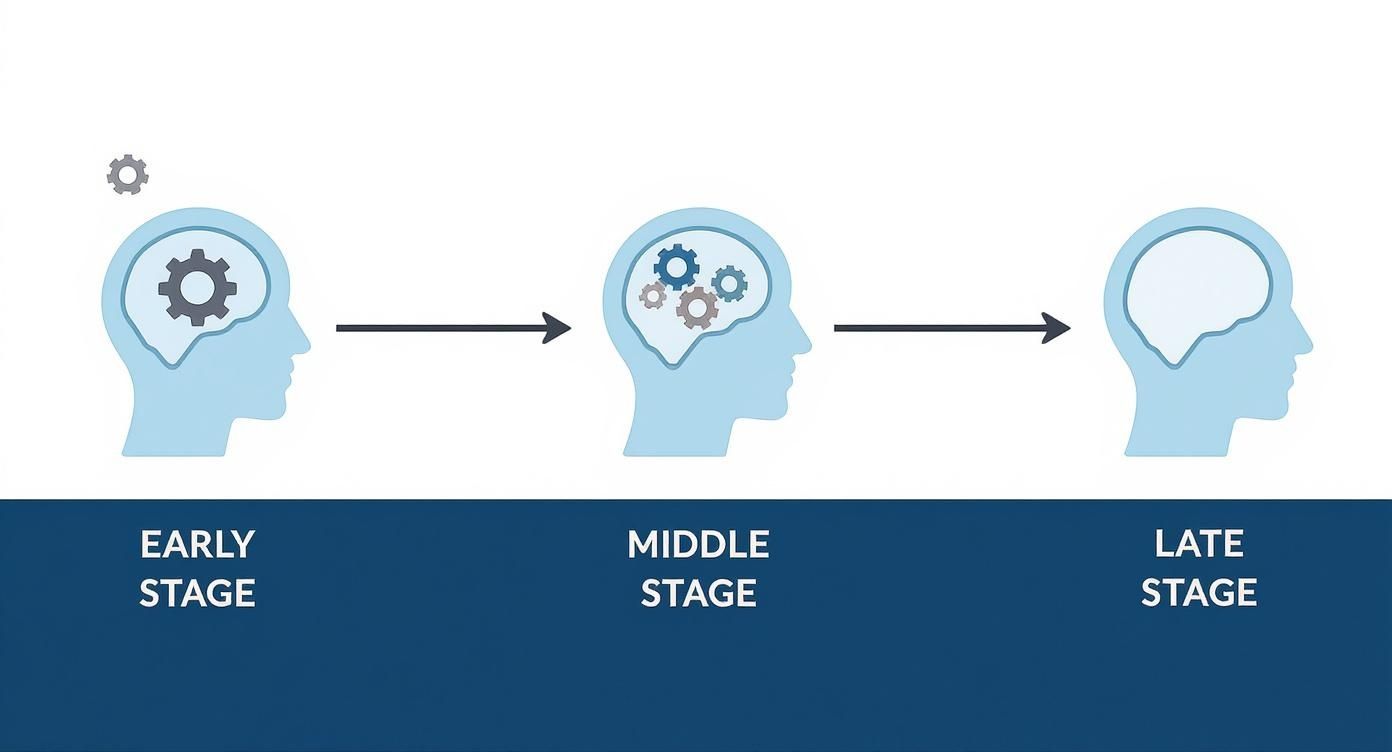
You can see how the brain’s “gears” are impacted more and more over the years, which is exactly why a flexible, personalized care plan is so essential.
The Early Stage (Mild Alzheimer’s)
In the early stage, a person with Alzheimer’s can still function quite independently. They might still be driving, socializing with friends, and handling most parts of their life on their own.
But you might notice small things. They might feel like they’re having memory lapses—forgetting a common word or where they put their keys. It’s more than just occasional forgetfulness.
Families in Arlington or Alexandria might see a loved one start to struggle with planning or organizing. This could look like trouble managing the household budget, keeping track of appointments, or following a recipe with several steps. The changes are subtle but consistent.
Support during this phase is all about creating helpful routines and memory aids. Simple tools like calendars, sticky notes, and phone alerts can empower someone to hold onto their independence for as long as possible.
The Middle Stage (Moderate Alzheimer’s)
The middle stage is often the longest, sometimes lasting for many years. As the disease moves forward, the need for care becomes much more obvious. Damage to the brain cells starts making it tough to express thoughts clearly or get through routine tasks without help.
During this time, the changes become more pronounced. You might see:
-
Deeper Memory Loss: Forgetting significant personal details, like their own address or where they went to high school.
-
Personality and Behavioral Shifts: They may become confused, suspicious, or act out in ways that are completely out of character.
-
Confusion about Time and Place: Wandering is common, and they can get lost even in familiar places like their own neighborhood.
-
Changes in Sleep Patterns: It’s not uncommon for them to sleep more during the day and become restless or agitated at night.
Personal care, like picking out clothes for the day or remembering to bathe, becomes a real challenge. This is often the point when families in Northern Virginia realize professional support is needed to keep their loved one safe and well. Keeping their mind engaged is also vital; we have some great ideas in our article about elderly games for dementia.
The Late Stage (Severe Alzheimer’s)
In the final stage, individuals eventually lose their ability to interact with their environment, have a conversation, or control their movements. At this point, they rely completely on others for every aspect of their care.
During the late stage, communication becomes almost entirely nonverbal. The focus of care shifts to providing comfort, preserving dignity, and ensuring the highest possible quality of life.
Round-the-clock care becomes essential to help with all daily activities, from eating and walking to using the bathroom. While memory and cognitive abilities are severely damaged, they may still find comfort in touch, music, or other sensory experiences that create a feeling of connection. It’s a time for compassionate, hands-on support.
To give you a clearer picture, here’s a quick overview of how the stages compare.
Overview of Alzheimer’s Stages and Care Needs
| Stage | Key Characteristics | Common Care Needs |
|---|---|---|
| Early Stage (Mild) | Minor memory lapses, difficulty with planning. Still largely independent. | Memory aids (calendars, notes), establishing routines, emotional support. |
| Middle Stage (Moderate) | Significant memory loss, confusion, personality changes, wandering. | Supervision for safety, help with daily tasks (dressing, bathing), structured activities. |
| Late Stage (Severe) | Loss of speech and mobility, inability to respond to surroundings. | 24/7 hands-on assistance with all personal care, focus on comfort and sensory connection. |
This table helps illustrate the progressive nature of the disease and why caregiving strategies must adapt to meet the changing needs of your loved one.
How Doctors Diagnose and Treat Alzheimer’s
Figuring out if someone has Alzheimer’s disease isn’t as simple as a single blood test. Instead, doctors have to become detectives, piecing together clues from multiple sources to build a complete picture of a person’s brain health. For families in Arlington, this journey usually begins with a conversation at their primary care physician’s office.
This comprehensive evaluation is designed to rule out other possible causes for the symptoms, like thyroid problems, vitamin deficiencies, or even side effects from medication. A thorough diagnosis is what gives families clarity and a real path forward.
The Diagnostic Process
Doctors use several tools to determine if Alzheimer’s is the likely culprit behind cognitive changes. It’s a careful, methodical process with multiple steps to ensure they get it right.
A typical evaluation includes:
-
Medical and Family History: The doctor will ask detailed questions about the person’s health, any past medical issues, and whether there’s a family history of dementia or Alzheimer’s.
-
Cognitive and Neurological Exams: These tests are designed to assess memory, problem-solving skills, and language abilities. The doctor will also check reflexes, balance, and coordination to look for other neurological issues.
-
Brain Imaging: Scans like an MRI or CT scan can give doctors a look at the brain’s structure. While these can’t diagnose Alzheimer’s on their own, they are crucial for identifying other problems like tumors, evidence of strokes, or fluid buildup that could be causing the symptoms.
This multi-faceted approach is absolutely essential because so many other conditions can mimic the early signs of Alzheimer’s. A careful, thorough diagnosis ensures your loved one receives the most appropriate care and treatment for their specific situation.
Alzheimer’s is a fast-growing global health crisis, and its prevalence is rising as populations get older. Shockingly, every three seconds, someone in the world develops dementia, a statistic that really highlights the urgency of this issue. If these trends hold, the number of people living with dementia worldwide could jump from over 55 million today to more than 152 million by 2050. To see the full scale of this challenge, you can read more about global dementia trends.
Treatment Strategies Beyond Medication
While there is currently no cure for Alzheimer’s, a combination of medical and non-medical strategies can significantly improve a person’s quality of life. Medications might help manage some cognitive symptoms for a time, but they are just one piece of a much larger puzzle.
Non-pharmacological approaches are just as important, focusing on creating a safe, supportive, and engaging environment. These strategies help manage behavioral symptoms, reduce agitation, and promote a sense of well-being. This is where high-quality dementia care in Northern VA becomes so vital.
Creating a supportive environment involves:
-
Establishing Consistent Routines: A predictable daily schedule for meals, activities, and rest can reduce confusion and anxiety.
-
Promoting Social Engagement: Regular interaction with family, friends, and caregivers helps combat feelings of isolation and depression.
-
Encouraging Physical Activity: Gentle exercise, like a daily walk, can improve mood, sleep, and overall physical health.
These strategies are the bedrock of effective in-home Alzheimer’s care. By focusing on the whole person—not just the disease—we can help individuals in Arlington, Fairfax, and McLean live with greater comfort, dignity, and purpose.
The Comfort of In-Home Alzheimer’s Care in Northern Virginia
When someone is living with Alzheimer’s, their world can start to feel unpredictable and confusing. The familiar sights, sounds, and routines of home aren’t just comforts; they become powerful anchors. They provide a sense of stability, safety, and identity when memory begins to fade.
This is why professional in-home care is so often the most compassionate and effective choice for families here in Northern Virginia.

A structured, calm home environment can make a world of difference, significantly reducing the agitation and disorientation that are so common with the disease. By allowing a senior to stay in the place they know and love, we help preserve their sense of self and dignity. At Caring Senior Service of Arlington, our entire approach is built around this idea, using our GreatCare™ method to deliver truly specialized support.
Quality Caregivers and Specialized Training
The foundation of exceptional dementia care isn’t a program or a checklist—it’s the caregiver. Our caregivers are more than just helpers. They are trained professionals who truly understand the nuances of Alzheimer’s and learn patience, consistent communication techniques, and how to manage challenging behaviors with empathy.
This specialized training is absolutely essential. It ensures every interaction is supportive and helps build a trusting relationship that becomes a reliable source of comfort for your loved one. That consistency is key to minimizing stress and creating a peaceful daily routine.
For anyone providing or looking into professional support, understanding these approaches is crucial. You can find some valuable essential care tips for dementia patients that cover practical strategies for communication, behavior management, and daily support.
Customized Care Plans That Evolve
Alzheimer’s is a progressive disease, which means a person’s needs will change over time. A care plan that works perfectly today might not be enough six months down the road. That’s why our Customized Care Plans are designed to be dynamic, evolving right alongside your loved one’s journey.
This flexible approach ensures they get the right level of support at every stage:
-
Early Stage: Support might start with simple companionship, meal prep, and help with errands to encourage independence and keep them socially engaged.
-
Middle Stage: As the disease advances, care can grow to include hands-on help with personal care, medication reminders, and safety supervision to prevent wandering.
-
Late Stage: In the final stages, our caregivers provide compassionate, comprehensive support with all daily activities, focusing on comfort and preserving dignity above all else.
Active Involvement With Northern Virginia Families
We firmly believe that the best care comes from a true partnership. Our Active Involvement with families in Arlington, Alexandria, and Falls Church is central to how we work. We keep the lines of communication wide open, providing regular updates and working with you to continuously adjust the care plan as needed.
This partnership ensures that you remain a vital part of your loved one’s care team. Your insights and our expertise come together to create a support system that is truly responsive to your family’s unique situation.
Ultimately, our goal is to empower seniors to live safely and with dignity in the place they love most. By providing expert, compassionate in-home dementia care, we help manage the challenges of Alzheimer’s while improving your loved one’s quality of life.
Common Questions Families Ask About Alzheimer’s
When a loved one receives an Alzheimer’s diagnosis, your mind can feel like it’s spinning with a million questions at once. It’s completely normal. Families often find themselves wading through a flood of information, trying to figure out what’s what, and the whole experience can be overwhelming.
Think of this section as a straightforward conversation where we tackle some of the most common concerns we hear from families right here in Northern Virginia. Our goal is to cut through the noise and give you clear, compassionate answers so you can feel more prepared for the journey ahead.
Is Alzheimer’s the Same Thing as Dementia?
This is probably the most frequent question we get, and it’s a great one. No, they aren’t the same, but they are very closely connected.
The easiest way to think about it is to picture dementia as a big umbrella. It’s the general term for a group of symptoms—like memory loss or confused thinking—that are severe enough to get in the way of daily life.
Alzheimer’s disease is just the most common type of dementia that falls under that umbrella. In fact, it accounts for an estimated 60-70% of all dementia cases. So, while every person with Alzheimer’s has dementia, not everyone with dementia has Alzheimer’s disease.
Can Alzheimer’s Disease Be Prevented?
While there’s no guaranteed way to prevent Alzheimer’s, a ton of research points to one powerful conclusion: a brain-healthy lifestyle can make a real difference and significantly lower your risk. It turns out that what’s good for your heart is also fantastic for your brain.
Here are the key areas to focus on:
-
Managing Heart Health: Keeping your blood pressure, cholesterol, and blood sugar in a healthy range is one of the most protective things you can do.
-
Eating a Balanced Diet: A diet loaded with fruits, vegetables, and lean proteins gives your brain the fuel it needs to function at its best.
-
Staying Physically Active: Regular exercise gets blood flowing to the brain and can even help grow new brain cells.
-
Keeping Your Mind Engaged: Never stop learning! Socializing, picking up new hobbies, and challenging your mind help build up your brain’s resilience over time.
What Is the Life Expectancy After a Diagnosis?
This is a tough question because the answer varies so much from person to person. It really depends on their age when diagnosed, their overall health, and any other medical issues they might have. On average, a person may live anywhere from four to eight years after their diagnosis.
However, that’s just an average. We’ve known people who have lived for as long as 20 years with the disease. The most important thing to remember is that the goal of Alzheimer’s care is always to focus on maximizing comfort, preserving dignity, and ensuring the best possible quality of life at every single stage.
How Can I Get Help in Arlington, VA?
Your first step should always be to see a doctor for a complete medical evaluation. This will confirm the diagnosis and rule out any other conditions that could be causing the symptoms. Once you have a clear picture, professional in-home care services like Caring Senior Service of Arlington can be a lifeline.
We build personalized care plans designed to help your loved one stay safe, comfortable, and engaged in the familiar surroundings of their own home. In the early stages, that might mean companionship and help with meals. As the disease progresses, it can shift to more comprehensive personal care. The best way to get started is just to have a conversation with one of our care specialists.
At Caring Senior Service of Arlington, we help seniors across Northern Virginia remain safe, healthy, and happy at home. Call us at (571) 202-6522 to schedule a free consultation today.
https://caringseniorservice.com/arlington