
For families in Arlington and across Northern Virginia, learning that a veteran you love needs daily help can be overwhelming. The VA Aid and Attendance benefit is a crucial resource, but the application process can feel complex. This isn’t a one-time grant; it’s an enhanced monthly pension—an add-on to the basic VA pension—designed for wartime veterans and their surviving spouses who require assistance with everyday activities.
Understanding this benefit and how to apply for it can be a lifeline, providing the financial means to afford quality care that allows a senior to remain safe and comfortable at home.
Getting Clear on the VA Aid and Attendance Benefit

Many families in Arlington, Fairfax, and Alexandria have heard of Aid and Attendance, but the specifics can be fuzzy. In simple terms, it's a monthly, tax-free payment for veterans who can no longer manage their daily care independently.
The funds go directly to the veteran or surviving spouse, empowering them to choose the care setting that best suits their needs. This money can be used to pay for:
- Professional In-Home Care: A top choice for many, as it allows seniors to age in the comfort and familiarity of their own Northern Virginia homes.
- Assisted Living Communities: The benefit can help offset the monthly costs of facilities that provide daily support.
- Nursing Home Care: It provides financial assistance for those who require long-term, skilled nursing services.
At its core, the goal is to help shoulder the high costs of long-term care, ensuring veterans who served our country receive the support they deserve to live with dignity.
To give you a quick snapshot before we dive deeper, here’s a simple table breaking down the main requirements.
VA Aid and Attendance At a Glance
| Eligibility Pillar | What It Means for Applicants |
|---|---|
| Military Service | Must have served at least 90 days of active duty, with at least one day during a wartime period. |
| Medical Need | Requires documented help with daily activities like bathing, dressing, or eating. |
| Financial Limits | Income and assets must fall below a certain threshold set by the VA. |
Think of this table as your starting point. If these pillars seem to fit your situation, it’s definitely worth exploring the application process.
What Kind of Financial Support Are We Talking About?
The financial assistance can be substantial and often makes the difference between affording quality care and going without. For instance, in 2026, a single veteran with no dependents who qualifies for the A&A benefit could receive a maximum annual pension of $29,093—which breaks down to about $2,424 a month. For a veteran with a spouse, that number jumps to $34,488 a year, or $2,874 a month.
It’s always a good idea to check the most current VA pension rates to see the exact figures for your specific situation.
This tax-free monthly payment helps close the financial gap that so often keeps seniors from getting the help they need. It gives them the means to hire a qualified caregiver for assistance with bathing, dressing, making meals, and medication reminders. If you’re new to this world, understanding what a home health aide does can really clarify how these funds translate directly into a safer, better quality of life.
Why This Benefit Is a Game-Changer for Arlington Families
Here in Northern Virginia, the high cost of living—and long-term care in particular—makes this benefit especially impactful. It gives veterans the ability to afford the one-on-one attention that professional in-home care provides. This level of personalized support, with caregivers carefully matched to a senior’s needs and personality, is often the key to maintaining their independence for as long as possible.
The real purpose of Aid and Attendance is to create a protected, supportive environment for our vulnerable veterans. It’s the VA’s way of recognizing that needing help with personal care is a legitimate medical expense and providing the funds to meet that need.
By breaking down what this benefit is and who it’s for, our hope is to give your family a clear, straightforward path to securing the support your loved one has earned.
Confirming Your Eligibility Before You Apply
Before you get lost in a sea of paperwork, the very first step is to make sure you or your loved one actually meets the VA’s core requirements. I always tell families to think of it as a three-legged stool. If one leg is missing, the whole thing falls over.
You have to satisfy the military service, medical need, and financial criteria to even get your application off the ground.

Many Arlington families I talk to feel overwhelmed by the process, but when you break it down into these three pillars, it becomes much more manageable. Let’s take them one by one.
The Military Service Requirement
This is the foundation. For the VA pension that Aid and Attendance is built on, the veteran must have a specific kind of service record. It’s not just about having served, but also about when that service occurred.
The veteran must have served at least 90 days of active duty, with at least one of those days falling during a recognized wartime period. A key point here is that the veteran did not have to serve in combat—they only had to be on active duty during the designated dates.
The term “wartime veteran” can be a bit misleading. A veteran who served stateside in Arlington during the Vietnam era, for instance, can still meet this requirement as long as their active duty dates line up with the VA’s official periods.
The official wartime periods are:
- World War II: December 7, 1941 – December 31, 1946
- Korean Conflict: June 27, 1950 – January 31, 1955
- Vietnam War Era: November 1, 1955 – May 7, 1975 (for veterans in Vietnam) or August 5, 1964 – May 7, 1975 (for veterans outside Vietnam)
- Gulf War: August 2, 1990 – present (an end date will be set in the future)
Finally, the veteran’s discharge must have been honorable or under conditions other than dishonorable.
The Medical Need for Aid and Attendance
This is the part that gives the benefit its name. The VA needs to see clear, documented medical evidence that the applicant needs regular help from another person to handle their basic daily activities.
Just being older or having a chronic illness isn’t enough. Your loved one must meet at least one of these clinical criteria:
- They need help with activities of daily living (ADLs), like bathing, getting dressed, eating, or using the toilet.
- They are bedridden, meaning their health forces them to stay in bed for a large part of the day.
- They live in a nursing home because of a physical or mental disability.
- They have very poor eyesight (vision of 5/200 or less in both eyes).
A statement from a physician is absolutely critical here. The doctor needs to clearly describe the specific conditions and explain exactly why the applicant needs daily, hands-on assistance. This letter becomes a cornerstone of a successful application.
The Financial Standing Rules
For many families in Northern Virginia, this is the trickiest part, since assets and income can be higher here. The VA examines two main things: net worth and countable income.
As of late 2025, the VA’s net worth limit is $159,240. This number includes your assets (like stocks, bonds, and savings) plus your annual income. The good news is that your primary home and personal vehicle do not count toward this limit.
Next up is your Income for VA Purposes (IVAP). This is where a lot of people who think they won’t qualify find out they actually do. The VA lets you subtract unreimbursed medical expenses from your gross income.
For example, the cost of hiring a professional in-home caregiver—the very help this benefit is for—can be deducted. So, if a veteran’s monthly income is $3,000, but they pay $2,500 for in-home care, their “countable” income in the VA’s eyes is only $500. This is the single most important tool for meeting the financial requirement. Our guide on VA Aid and Attendance eligibility breaks down the numbers in more detail.
Since VA Aid and Attendance is often part of long-term care planning in retirement, finding the right financial professional can be a game-changer. A good advisor can help you structure your finances to align with VA rules while securing your future.
Gathering Your Essential Documents
A delayed or denied application for VA Aid and Attendance often boils down to one simple thing: missing paperwork. I’ve seen it happen time and again. Organizing your documents upfront is the single best way to prevent frustrating back-and-forth with the VA.
Think of it as building your case—every piece of paper is a crucial block in a strong foundation. This process involves proving three things: who the veteran is, what their medical needs are, and what their financial situation looks like.
Let’s break down exactly what you need for each category.
Military Service Documentation
This is the non-negotiable starting point. The VA needs official proof of the veteran’s service history to confirm they meet the active duty and wartime service requirements.
The most important document here is the DD-214, Certificate of Release or Discharge from Active Duty. This single form contains everything the VA needs to verify service dates, duration, and the character of discharge.
If you can’t find the DD-214, don’t panic. You can request a free copy from the National Archives. It’s a common issue, and they have a straightforward process for veterans and next-of-kin to get replacement service records.
Medical and Health Records
Here, your goal is to paint a clear picture of why the applicant needs daily assistance. This evidence must come from a medical professional and be specific about the applicant’s limitations.
- Physician’s Statement: This is the cornerstone of your medical evidence. Your doctor must detail the specific conditions causing the disability and explain why the applicant needs help with activities of daily living (ADLs) like bathing, dressing, or eating. A vague letter won’t cut it; it needs to connect the diagnosis to the need for hands-on care.
- VA Form 21-2680: This form, titled “Examination for Housebound Status or Permanent Need for Regular Aid and Attendance,” should be completed by the applicant’s physician. It guides the doctor to provide the exact information the VA is looking for, which makes everyone’s job easier.
- List of Current Medications: Include a complete list of all prescriptions, over-the-counter drugs, and supplements.
- Care Plan Agreement: If you already have in-home care services, the service agreement from the agency is vital. It documents the type of care being provided and, critically, the monthly cost. This is essential for the financial part of the application.
A strong physician’s statement doesn’t just list diagnoses. It explains the functional impact. For instance, “Due to severe arthritis and poor balance, the patient requires standby assistance for showering to prevent falls.” That’s the kind of detail the VA needs to see.
Financial Disclosure Documents
The VA needs a complete and transparent look at the applicant’s income and assets to determine financial eligibility. Gather everything you can that shows the full picture.
Proof of Income:
- Social Security benefit statements
- Pension award letters
- Annuity statements
- Interest or dividend statements from investments
- Rental property income records
Proof of Assets:
- Bank statements (checking and savings) for the last 3-4 months
- Statements for stocks, bonds, mutual funds, and other investments
- Information on any property other than the primary residence
Proof of Medical Expenses:
- Health insurance premiums (Medicare, supplemental plans, etc.)
- Receipts for recurring medical supplies or prescriptions
- Invoices or service agreements for in-home care or assisted living costs
This documentation is what allows you to deduct unreimbursed medical expenses from your countable income. Properly documenting these costs, especially for professional in-home care, is often the key to meeting the VA’s income threshold.
Applying for VA Aid and Attendance starts with confirming eligibility. Veterans must have served 90 days active duty with at least one during wartime, be 65+, totally disabled, or in a nursing home, plus have income below MAPR limits like $29,091 yearly for a solo A&A veteran in 2026. Once eligibility is confirmed, the process involves filing specific VA forms and submitting all the documents we’ve listed here.
For a deeper dive into how these benefits work for Northern Virginia families, check out our overview of veteran benefits in Arlington.
Completing and Submitting Your Application
Once you have all your essential documents gathered, it’s time to tackle the application itself. This is where you translate your loved one’s story into the language the VA understands, and that happens primarily through VA Form 21P-527EZ, the Application for Pension. Let me be clear: accuracy and attention to detail here are absolutely critical. Little mistakes can lead to big delays.
The process can feel intimidating, but it’s really about being methodical. We’ll walk through the most important sections and the different ways you can submit the final package to give you the best shot at a smooth approval.
This visual flow helps simplify what you’re doing. Think of it as building a case with three main pillars of documentation—Military, Medical, and Financial—that all come together in your application.
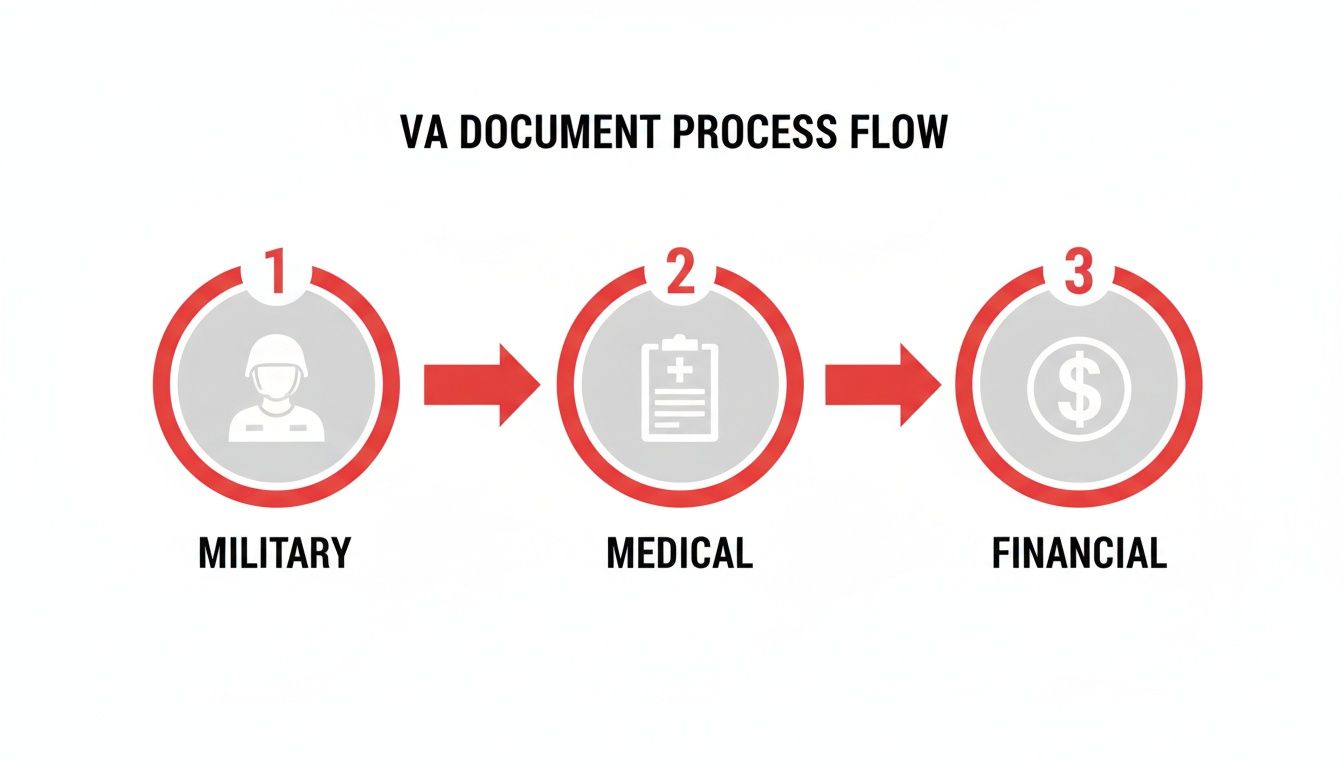
As you can see, a successful application hinges on providing solid proof for each category. You want to give the VA a complete and undeniable picture right from the start.
Mastering the Application Form
The 21P-527EZ form is where many Arlington families I’ve spoken with get tripped up, especially when it comes to reporting finances. The key is to be absolutely precise with income, assets, and—most importantly—medical expenses.
A very common mistake I see is people just listing gross income without properly deducting allowable medical costs. This is the whole ballgame! You have to clearly itemize all unreimbursed medical expenses—everything from insurance premiums to the cost of in-home care—to reduce what the VA considers “countable income.”
This is also where a detailed service agreement from a home care agency becomes invaluable. It serves as official documentation of your monthly care costs, which is exactly the kind of proof the VA needs to see to approve that deduction.
Choosing Your Submission Method
You’ve got three main options for getting the completed application into the VA’s hands. Each has its pros and cons, so think about what works best for your comfort level and timeline.
- Online via VA.gov: This is usually the fastest and most efficient way to do it. You get an instant confirmation that your application was received, which cuts out any mailing delays and the anxiety that comes with them.
- By Mail: You can mail your completed forms and all supporting documents to the Pension Management Center (PMC) that covers Virginia. A word of advice: always send copies, never originals, and spend the few extra dollars for certified mail so you can track your package.
- In-Person at a Regional Office: You can also take your application directly to a VA regional office. This can be helpful if you have last-minute questions, but you’ll likely need to make an appointment.
Key Takeaway: No matter which method you pick, the quality of the information you submit is what truly counts. A complete, well-documented application is far more likely to be processed smoothly than a rushed, incomplete one you fired off online.
Why a Veterans Service Officer Is Your Best Ally
You absolutely do not have to go through this process alone. Accredited Veterans Service Officers (VSOs) are trained professionals who offer free assistance to veterans and their families. It’s their job to help you get this right.
Working with a VSO is one of the smartest moves you can make. They are experts in VA procedures, can review your application to spot potential errors, and will advocate on your behalf. This can significantly improve your chances of a successful outcome. You can find VSOs through organizations like the VFW, American Legion, and your local county veterans’ affairs office.
The financial impact of this benefit is significant. The 2.8% COLA increase for 2026 VA pensions pushes the annual payment for a single veteran needing Aid and Attendance to $29,093, or about $2,424 a month. The net worth limit for eligibility is $163,699, a figure that thankfully excludes the primary home and vehicle. Yet despite these numbers, VA statistics show only about 40% of eligible veterans ever apply, leaving billions in earned benefits on the table each year.
Properly documenting care needs and their associated costs is the foundation of a successful claim. If you have questions about setting up a service plan that meets the VA’s requirements, our team is here to help. Feel free to contact our Arlington office for guidance on how in-home care can be structured for your application.
Navigating the Wait and Potential Outcomes
Once you’ve sent in the application for VA Aid and Attendance, a new phase begins: the waiting period. For many families I’ve worked with, this is often the hardest part, a time filled with a lot of uncertainty. Setting realistic expectations from the very start is key.
While every single case is different, it’s a good rule of thumb to expect the VA to take somewhere between three to six months to process a claim. Sometimes it’s faster, but mentally preparing for a longer wait really helps manage the stress. Remember, a well-organized and complete application is your best defense against unnecessary delays.
Keeping an Eye on Your Claim Status
The good news is you don’t have to wait completely in the dark. The VA offers tools so you can track how your application is moving along. The simplest way is to check your claim status online through your VA.gov account. This portal gives you updates as your file makes its way through the system.
During this time, don’t be surprised if the VA sends you a letter asking for more information or some clarification. This happens all the time and is not a cause for alarm. The best thing you can do is respond as quickly and completely as possible to keep your application moving forward.
It’s crucial to understand that a request for more evidence isn’t a bad sign. It means a VA rater is actively working on your case and just needs to fill in a few gaps. Prompt and thorough responses are key.
Understanding the Possible Decisions
After the review is complete, you will receive a formal decision letter from the VA. Generally, there are three outcomes you can expect:
- Approval: If your application gets the green light, the letter will break down the benefit amount and the effective date. The VA pays benefits retroactively to the date they first received your application, so you should receive a lump-sum payment for all the months you were waiting.
- Denial: Getting a denial can feel incredibly disheartening, but it is not the end of the road. The letter will explain the specific reasons for the decision, which is valuable information you can use if you decide to file an appeal.
- Request for More Evidence: Sometimes, the “decision” is actually another request for specific documents before a final call can be made.
What Happens After an Approval
If you receive an approval, congratulations! That’s wonderful news. The next step is to figure out how the benefit impacts your finances. That retroactive payment can be quite substantial and is a huge help for covering care expenses that you’ve already paid for.
From that point on, you’ll receive a monthly payment. It’s smart to use these funds to create a sustainable, long-term care plan. Many families use this benefit to pay for professional in-home care, which perfectly aligns with the purpose of the Aid and Attendance program. Our guide on the cost of home care in Northern Virginia can help you budget and plan how to best use these new funds.
Next Steps if Your Claim Is Denied
If your claim is denied, take a deep breath. You absolutely have the right to appeal the decision. The first thing to do is carefully read that denial letter to understand exactly why the VA said no. Common reasons often boil down to missing medical evidence or issues with the financial calculations.
This is where an accredited VSO becomes an indispensable ally. They can help you make sense of the denial, figure out what evidence you need to gather for an appeal, and formally submit it on your behalf. Think of a denial as a hurdle, not a final stop, in the journey to securing the benefits your loved one has earned.
Got Questions? Let’s Get Them Answered
Even with a detailed guide, it’s completely normal to have questions about how the VA Aid and Attendance benefit works for your family’s specific situation. Here in Northern Virginia, we hear a lot of the same worries from families who are new to this process. Let’s clear up some of the most common questions we get.
Can we use Aid and Attendance to pay for in-home care in Arlington?
Absolutely. In fact, that’s one of the most powerful ways families use this benefit. The money is paid directly to the veteran or surviving spouse, which means you have total control over your care choices.
You can use that monthly payment to hire a professional home care agency like Caring Senior Service of Arlington. The great part is that the cost of this care is considered a deductible medical expense—a key piece of the puzzle for meeting the VA’s financial eligibility rules. An individualized service plan ensures your loved one gets the right support, from personal care to companionship, while also providing the documentation needed for your application.
How long does the approval process typically take?
I always tell families to be patient with this one. While every application is different, you should realistically expect the process to take anywhere from three to six months. It’s just the reality of how these claims are processed.
The single best way to keep things moving is to submit an application that’s rock-solid from the start. Working with an accredited Veterans Service Officer (VSO) can be a game-changer. They’ll review everything with a trained eye to spot potential issues before you even mail it in.
From my experience, one of the biggest holdups is a weak physician’s statement. You need your doctor to clearly connect your loved one’s medical conditions to their specific need for daily, hands-on help. A vague description can easily stall an application for months.
What if our income is a little too high?
This is a big one, and it trips up so many families. Don’t just look at your gross income and assume you won’t qualify. The VA has a system that allows you to deduct all your unreimbursed medical expenses to get to what they call your “countable income.”
For many seniors living in Arlington, Fairfax, and Alexandria, the cost of living—and healthcare—is high. Those expenses can really add up. You can deduct things like:
- Health insurance premiums (including Medicare Parts B and D)
- Prescription medication costs
- The monthly fees for professional in-home care services
When you properly document all of these costs, especially the significant expense of in-home care, it can often lower your countable income enough to get you under the VA’s limit. Suddenly, you’re eligible.
Can a veteran with dementia apply for this benefit?
Yes, and they are often very strong candidates. The need for assistance isn’t just about physical tasks like bathing or getting dressed.
The key here is proving the need for what the VA calls a “protected environment.” If someone needs supervision to keep them from wandering, to make sure they take their medication, or to protect them from daily hazards because of memory loss, that absolutely counts. A tailored care plan that includes active family involvement and ongoing supervisory visits helps demonstrate this need. The physician’s report must clearly document this need for constant supervision to ensure the veteran’s health and safety.
Would it help to see what an individualized at-home plan might look like for your dad—timing, safety tweaks, and caregiver match? Caring Senior Service of Arlington helps seniors across Northern Virginia remain safe, healthy, and at home. Call (571) 202-6522 or visit us at 1950 Old Gallows Rd, Ste #550 for a free consult—our office coordinates scheduling 24/7.